
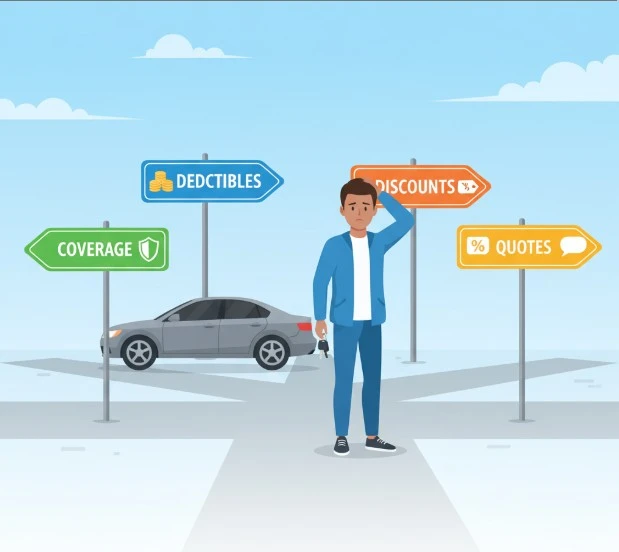
A few years back, I got my car insurance renewal notice in the mail and nearly choked on my morning chai. My premium had jumped by almost 22% — for no accident, no ticket, nothing. I called the insurer assuming it was a mistake. It wasn’t. Turns out, I had unknowingly made several small decisions over the past year that quietly stacked up and inflated my rate.
That experience sent me down a rabbit hole of researching how car insurance actually works — not the brochure version, but the real mechanics behind it. What I found was honestly surprising. A lot of the things people do (or don’t do) that raise their premium aren’t obvious at all. Some of them are things you’d never think twice about.
So here’s what I’ve learned — partly from my own experience, partly from conversations with insurance agents, and partly from obsessively reading the fine print that nobody reads.
1. Not Shopping Around at Renewal Time
This is probably the single biggest mistake people make, and I was guilty of it for years.
Most of us sign up with an insurer, set up auto-pay, and forget about it. The problem? Insurance companies count on that loyalty — and they charge you for it. There’s actually a term for it: “price optimization.” Basically, companies use data to identify customers who are unlikely to switch, and they quietly raise those customers’ rates year after year.
When I finally used an aggregator like PolicyBazaar (if you’re in Pakistan or India) or The Zebra and NerdWallet (for the US folks), I found quotes that were 15–30% cheaper for the same coverage. Same coverage. Different company. Just like that.
What to do: Set a calendar reminder 45 days before your renewal date. Get at least three quotes. You don’t have to switch every year, but just knowing what else is out there gives you leverage — even to negotiate with your current provider.
2. Choosing the Lowest Deductible Without Thinking It Through
When I first bought insurance, the agent asked if I wanted a low deductible. I said yes immediately. Who wouldn’t want to pay less out-of-pocket if something goes wrong?
But here’s what nobody explains clearly: the lower your deductible, the higher your monthly premium. Always. If you raise your deductible from, say, PKR 10,000 to PKR 25,000 (or $250 to $1,000 in the US), your annual premium can drop significantly — sometimes by 20-40%.
The real question is: how often do you actually make claims? If you’re a careful driver and your car is parked in a secure area, you might go years without ever touching your deductible. In that case, you’re basically paying extra every month for a cushion you’re not using.
Run the math. If a higher deductible saves you PKR 8,000/year on your premium, and you haven’t made a claim in 3 years, you’ve saved PKR 24,000 that you’d keep even if you had to pay the higher deductible once.
3. Ignoring Your Credit Score’s Impact on Premiums
This one genuinely surprised me when I first found out about it — especially for readers in the US, UK, and parts of Southeast Asia.
In many countries, insurers use your credit score as part of their risk calculation. The logic is that people who manage money responsibly tend to file fewer claims. Whether that’s fair is a whole separate debate, but the impact is real. A poor credit score can raise your premium by hundreds of dollars a year.
Apps like Credit Karma or Experian let you monitor your score for free. Even improving your score from “fair” to “good” over 12 months can meaningfully lower your next renewal rate.
4. Over-Insuring an Old Car
I had a 2009 Suzuki Alto for years. I was still paying for comprehensive coverage — full coverage including collision and theft — on a car worth maybe PKR 3–4 lakh at most.
The rule of thumb many insurance experts suggest: if your annual comprehensive premium costs more than 10% of your car’s current market value, you’re probably paying too much. At some point, if the car gets totaled, the insurer pays out its depreciated market value — not what you paid for it, not what it’s worth to you emotionally.
Check your car’s current resale value on platforms like PakWheels or Craigslist and compare that against what you’re paying. You might find that switching to third-party only (or liability-only) saves you a significant chunk of money every year.
5. Not Telling Your Insurer About Life Changes
Most people know that adding a young driver to your policy raises rates. What they don’t realize is that the opposite can be just as impactful — in a good way — if you actually report it.
Got married? In many countries, married couples statistically file fewer claims, so rates go down. Started working from home and driving less? You may qualify for a low-mileage discount. Moved to a safer neighborhood? That affects your rate too.
The problem is insurers don’t go looking for these changes. You have to report them. And if you don’t, you’re leaving money on the table every single month.
I know someone who didn’t update his address after moving from Karachi to a smaller city. He was still paying Karachi urban rates — some of the highest in the country — for a year after his move.
6. Making Too Many Small Claims
This is the one that people really don’t expect.
Let’s say a shopping cart scratches your door in a parking lot. Repair cost: PKR 8,000. Your deductible: PKR 5,000. So you file a claim for the PKR 3,000 difference.
That claim can follow you for 3–5 years and raise your premium by far more than PKR 3,000 annually. In the US, a single at-fault claim can raise premiums by 30–40% on average. Even a not-at-fault claim can have an impact with some insurers.
General rule: if a repair costs less than twice your deductible, pay for it out of pocket. Your future self will thank you.
7. Not Asking About Discounts
Insurance companies offer a ton of discounts — but they rarely volunteer the information. You have to ask.
Some discounts that are commonly available but frequently missed:
- Bundling discount — combining your car and home/renters insurance with the same company
- Safe driver discount — for going X number of years without a claim or ticket
- Anti-theft device discount — dashcams, GPS trackers, and steering locks can qualify
- Telematics/Usage-based discount — apps like Snapshot by Progressive or DriveSafe by Allstate track your driving habits and can offer significant savings to careful drivers
- Loyalty discount — staying with the same insurer for multiple years
- Occupation discount — some professions (teachers, engineers, civil servants) get lower rates
- Paying annually upfront — instead of monthly installments, paying the full year often saves 5–10%
I once called my insurer and just said, “Can you tell me every discount I might qualify for?” The agent went through a list and found two I wasn’t using. Saved me a few thousand rupees annually. Five-minute phone call.
8. Letting Your Coverage Lapse
Even a short gap in your insurance history is a red flag for insurers. If your policy expires and you go a few weeks without coverage — maybe you were switching providers or just forgot to renew — your next insurer may classify you as a higher-risk customer.
In some markets, a coverage lapse of even 30 days can push you into a more expensive risk bracket. Always make sure your new policy starts the same day your old one ends.
9. Insuring a High-Risk Vehicle Without Realizing It
Not all cars are insured equally. Insurers look at repair costs, theft rates, accident frequency, and engine size when calculating premiums. That sporty turbocharged car or a popular theft target can cost significantly more to insure than a less exciting but statistically safer sedan.
Before buying a car, it’s actually worth checking its insurance group rating. In the UK, tools like MoneySuperMarket’s car insurance group checker are great for this. In Pakistan, just asking two or three insurers for quotes on the model you’re considering can reveal big differences in cost.
10. Not Reading the Policy Before Signing
Last one — and possibly the most underrated mistake.
I get it, the policy document is long and boring. But the difference between what you think you’re covered for and what you’re actually covered for can be enormous. Things like:
- Geographical exclusions (not covered if driving in certain provinces or across borders)
- Exclusions for using your car for business purposes
- Conditions around who is allowed to drive your car
- How depreciation affects your payout
Spending one hour reading your policy could save you from a massive shock when you actually need to make a claim.
The Bottom Line
Car insurance doesn’t have to be this confusing, expensive thing you just accept. A lot of the cost increase comes from small, avoidable mistakes — some you make once and forget about, others that compound over time.
The biggest shift for me was treating insurance like a subscription I actively manage, not a bill I passively pay. Review it annually. Ask questions. Use comparison tools. And never assume your insurer is automatically giving you the best deal.
If you take one thing from this: get competing quotes before your next renewal. It takes 20 minutes and the savings can be real.



Pingback: What Happens If You Miss a Car Insurance Payment? - MotoPolicyHub