
A few years ago, I pulled into a grocery store parking lot during a nasty summer storm. Ten minutes later, I walked out to find a massive, rotted oak branch resting comfortably across the crumpled hood of my sedan. I wasn’t panicked at first. I felt a wave of smug satisfaction because I paid $195 every single month for what my agent called a “full coverage” policy.
But when I called the claims hotline while standing in the rain, my confidence dissolved. The agent informed me that while my policy would cover the physical damage to my car after my $1,000 deductible, it didn’t include a rental car option. If I wanted a set of wheels while my engine block was getting checked, that cash was coming directly out of my own pocket. I ended up spending $450 on a compact rental over the next two weeks, all while paying top dollar for what I thought was an ironclad safety net.
That was the day I realized “full coverage” is one of the most misunderstood phrases in the entire financial world. It isn’t a specific product you can buy off a shelf, nor is it an all-inclusive shield against every bad thing that can happen to your vehicle. It is a marketing term, a shorthand bundle used by insurance companies to wrap up several distinct protections. Let’s pull back the corporate curtain and look at what you are actually paying for.
What This Really Means
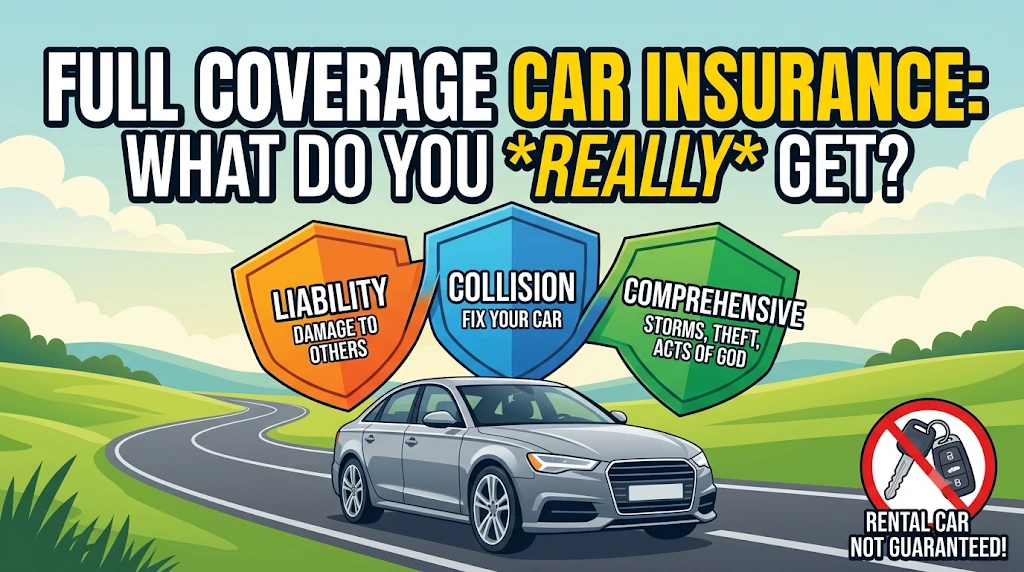
When an insurance agent or a slick online quote engine uses the term “full coverage,” they are typically referring to a policy that bundles three core components: state-mandated liability insurance, collision coverage, and comprehensive coverage.
| Liability | Collision | Comprehensive |
|---|---|---|
| Covers damage to other people, their vehicles, and property when you’re at fault. | Covers damage to your own vehicle from collisions (with another car or object). | Covers non-collision events like theft, storms, fire, vandalism, or natural disasters. |
If you strip away any of these layers, you no longer have a full coverage policy. To understand how they protect your bank account, you have to look at them as independent moving parts:
- Liability Coverage: This is the legal baseline required by almost every state. It doesn’t pay for your car at all. Instead, it pays for the bodily injuries and property damage you cause to other people when you slice through a red light or rear-end an SUV.
- Collision Coverage: This pays to fix or replace your own vehicle if you hit another car, a guardrail, a tree, or even if you flip your car over on an icy patch of road. It applies regardless of who caused the accident.
- Comprehensive Coverage: This handles the weird, unpredictable “acts of God” that happen when your car is sitting completely still. Think animal collisions, hail storms, vandalism, arson, or a thief driving your car away in the middle of the night.
Many drivers assume that choosing between third-party vs comprehensive car insurance which one actually makes sense for you is a simple binary choice. In reality, full coverage means you are bridging that gap completely by pairing the legal minimums with physical damage protection for your own asset.
Why This Happens: The Industry Insiders’ Perspective
Why do insurance companies keep using a phrase that leaves so many consumers confused? The answer comes down to sales psychology and risk management.
Insurers know that if they force you to sit down and select every single coverage option line-by-line, human nature kicks in. You start cutting corners to save a buck. You might say, “Well, I’m a great driver, so I don’t need collision,” or “I park in a garage, so let’s skip comprehensive.” By packaging these three core pillars into a neat phrase like “full coverage,” companies make the buying process simple and maximize their premium volume.
Industry Insight: Insurance companies operate on underwriting profit margins and combined ratios. They balance the cash collected from premiums against the claims paid out. Comprehensive and collision coverages are highly profitable for insurers when sold to low-risk drivers because major accidents are statistically rare for this demographic, yet the premiums are substantially higher than basic liability.
When you buy a full coverage policy, you aren’t just buying protection; you are engaging in a calculated risk-transfer agreement. The insurer looks at your data and calculates the mathematical probability of your car getting totaled. To protect their own margins, they require you to select a deductible—usually $500 or $1,000. This deductible is the insurer’s way of keeping you honest. By forcing you to have skin in the game, they ensure you won’t file a claim for every tiny scratch or ding, which would completely destroy their administrative efficiency.
Real Data & Cost Breakdown
The jump from a bare-minimum liability policy to a full coverage framework is a major financial step. It isn’t a small $10 add-on; it often doubles or triples your annual premium.
To give you an idea of how this looks on paper, consider the national average cost breakdown for a standard adult driver with a clean record:
- State Minimum Liability Only: $600 to $850 per year.
- Full Coverage Bundle (Liability + Collision + Comprehensive): $1,800 to $2,600 per year.
The premium cost doesn’t just fall out of the sky. It is divided across your policy layers based on specific risk factors. If you want to see exactly how these numbers shift behind the scenes, looking into how car insurance premium is calculated will show you how heavily your specific profile impacts the final invoice.
Liability Coverage (45%)
Collision Coverage (35%)
Comprehensive Coverage (20%)
Collision coverage is almost always more expensive than comprehensive coverage because human error is far more common than natural disasters. Insurers know you are much more likely to back into a concrete pole at a drive-thru than you are to have a meteor strike your hood.
Smart Strategies That Work
If you need full coverage—either because your lender mandates it or you can’t afford to replace your vehicle out of pocket—you don’t have to accept the first high quote that lands in your inbox. You can optimize the policy to keep your protections high and your costs manageable.
1. Optimize Your Deductible Threshold
Many drivers reflexively select a $250 or $500 deductible because they want to minimize their out-of-pocket costs during an accident. However, raising your deductible from $500 to $1,000 can slash your collision and comprehensive premium costs by 15% to 30%.
- Why it works: You are taking on more of the initial financial risk, which saves the insurer from processing small, expensive claims.
- Estimated Savings: $150 to $300 annually.
2. Audit and Remove Unnecessary Add-Ons
Your full coverage quote might be inflated by premium extras you don’t actually need. If you already have emergency roadside assistance through a premium credit card or an auto club membership, you are paying double by keeping it on your auto policy. Take a close look at the car insurance add-ons you should consider and a few you can skip to strip away the dead weight.
- Why it works: Eliminating duplicate services like rental car reimbursement or towing plans drops your baseline premium immediately.
- Estimated Savings: $50 to $120 per year.
3. Run the 10% Valuation Equation
If you own an older car that is fully paid off, full coverage might be a losing financial proposition. Take the current Kelley Blue Book value of your vehicle, subtract your deductible, and compare that to your annual premium. If your full coverage costs more than 10% of your car’s actual value, you are over-insuring the asset. Learning the nuances of the best car insurance for used cars can prevent you from throwing good money after a depreciating vehicle.
- Why it works: Dropping comprehensive and collision on an old vehicle eliminates the most expensive parts of your premium entirely.
- Estimated Savings: $400 to $800 annually.
4. Shop Around Immediately After a Rate Hike or Infraction
If you have had a recent speeding ticket or an at-fault fender bender, your current insurer will likely bump your rates at your next renewal cycle. Don’t simply accept it. Different insurers use different mathematical equations to evaluate risk. Implementing a dedicated strategy on how to lower car insurance after an accident can help you find a company that won’t penalize your past mistakes as severely.
- Why it works: Competing algorithms value past driving infractions differently, allowing you to find an insurer with a higher risk tolerance for your specific situation.
- Estimated Savings: 10% to 25% off your inflated rate.
Pros and Cons of Full Coverage
Before you hand over your credit card, you need to look objectively at the trade-offs of holding a full coverage policy.
Pros
- Comprehensive Asset Protection: If your vehicle is totaled in a multi-car wreck, stolen out of your driveway, or crushed by a fallen tree, the insurance company will write a check for the actual cash value of the car (minus your deductible).
- Lender and Lease Compliance: If you finance your car through a bank or lease it from a dealership, they legally own the title. Full coverage is non-negotiable for them because it protects their financial investment if you total the vehicle.
- Stress-Free Post-Accident Process: When you have collision and comprehensive coverage, your insurer will often handle the communication and repair arrangements directly with the other party’s insurance company, saving you dozens of hours of phone calls.
Cons
- Substantial Long-Term Cost: The premiums can accumulate rapidly. Over five years, paying for full coverage on a reliable commuter car can easily cost you over $10,000 in non-refundable premiums.
- The Deductible Barrier: If your car sustains $1,200 worth of damage and you carry a $1,000 deductible, your insurance policy only provides $200 of actual value, meaning you still have to pay for the bulk of the repairs yourself.
- No Protection for Depreciation: Full coverage does not guarantee you will get enough money to buy a brand-new car. It only pays out what your vehicle was worth the millisecond before the accident occurred.
Real-Life Scenario: The Story of Two Drivers
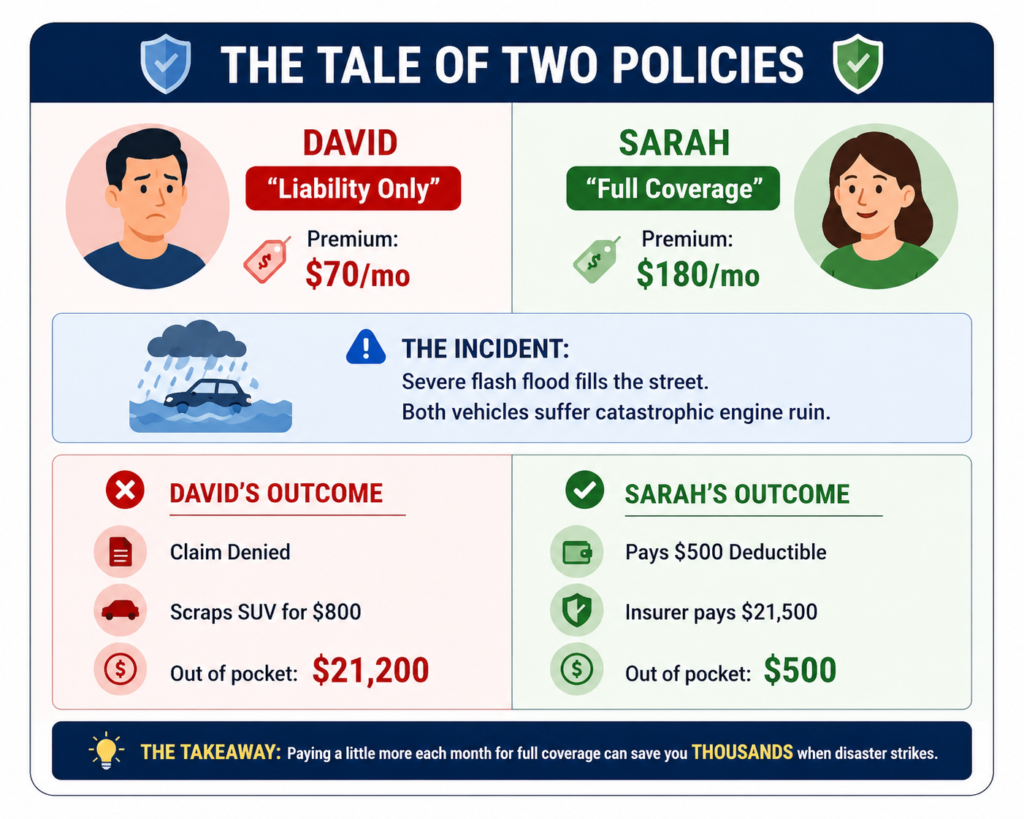
To see how these principles work out in the real world, let’s look at two hypothetical neighbors, David and Sarah. Both drive identical mid-sized SUVs valued at $22,000, and both live in the same neighborhood.
Driver A: David (The Minimum Approach)
David decided to cut his monthly expenses to the bone. He opted for a liability-only policy, paying just $70 a month. He reasoned that he was a defensive driver who hadn’t been in an accident for over a decade.
Driver B: Sarah (The Full Coverage Approach)
Sarah opted for a full coverage policy with a $500 deductible, which brought her monthly payment to $180. It felt like a hit to her monthly budget, but she wanted to protect her asset.
The Incident
During a severe spring storm, a flash flood swept through their street. Both David’s and Sarah’s SUVs were submerged up to the windows, completely ruining the electrical systems and destroying the engines. Both vehicles were declared a total loss by mechanics.
The Financial Outcome
David called his insurance provider, only to be reminded that liability coverage does not pay for weather damage to his own vehicle. His claim was denied. He had to scrap his ruined SUV for $800 and was left with no vehicle and no payout. He had to pull $21,200 from his retirement savings to purchase a replacement vehicle.
Sarah filed a claim under her comprehensive policy layer. Her insurer verified the storm damage, deducted her $500 choice, and issued her a check for $21,500. While she had paid more in premiums over the years, she avoided a devastating financial blow.
Policy Options Comparison Matrix
Understanding your policy options means looking at costs, advantages, and risks side-by-side:
| Policy Option | Average Cost Impact | Primary Benefit | Risk Level |
| Liability Only | Baseline Cost (Lowest) | Satisfies state legal mandates; protects your personal assets if you sue or damage others. | High: You are entirely responsible for fixing or replacing your own car out of pocket. |
| Full Coverage ($1,000 Deductible) | 20% to 30% lower than standard full coverage | Full physical protection against wrecks and storms with a manageable monthly premium. | Moderate: You must ensure you have $1,000 cash sitting in an emergency fund at all times. |
| Full Coverage ($500 Deductible) | 15% to 25% higher than a $1,000 deductible policy | Minimal out-of-pocket stress during an unexpected claim or collision. | Low: Maximum peace of mind, though you pay a premium for that security every month. |
| Full Coverage + Specialized Add-ons | Highest Premium Cost (Top Tier) | Includes rental car access, gap coverage, and roadside assistance automatically. | Very Low: Total protection, but you risk overpaying for overlapping coverages. |
Expert Insights: The Hidden Traps in the Contract
As an experienced finance writer, I have analyzed hundreds of insurance product structures. There are several subtle details built into standard full coverage frameworks that can completely catch you off guard if you don’t read your declarations page carefully.
The Actual Cash Value (ACV) Reality Check
If your car is totaled, your insurer will not pay you what you paid for the car, nor will they pay you enough to buy a brand-new model. They pay the Actual Cash Value, which factors in depreciation, mileage, and wear-and-tear.
If you drive a vehicle off the lot, it loses value immediately. If you wreck it three months later, your full coverage policy might pay out thousands less than what you still owe on your auto loan. To fix this specific issue, you need to look at what gap insurance actually covers to protect yourself from owing money on a car that’s sitting in a scrap yard.
Hidden Exclusions in the Fine Print
Full coverage policies contain a long list of explicit exclusions. Your comprehensive and collision lines will generally refuse to pay for:
- Damage caused by freezing temperatures or mechanical breakdowns (like a blown transmission).
- Aftermarket modifications (custom rims, specialized stereo systems, or lift kits) unless you declared them ahead of time and added a custom equipment rider.
- Accidents that happen while you are using your personal car for commercial purposes, like delivering food or driving for a ride-sharing app.
If you violate these terms, your claim can be completely thrown out. Reviewing real-world examples of why insurance claims get rejected can help you spot these coverage gaps before you file a claim.
The Payment Delivery Fine Print
How you choose to pay for your policy can secretly inflate your total costs. Many drivers choose monthly payment plans because a single annual invoice feels too heavy. However, insurance companies regularly tack on administrative installment fees of $3 to $7 per month if you don’t pay in full.
If you want to maximize your savings, look at the math breakdown between monthly vs annual car insurance which payment plan actually saves you more to see if you can skip those extra fees.
Who Should Consider This (And Who Can Safely Skip It)
Full coverage is a vital financial tool, but it is not a universal necessity for every single driver on the road.
Ideal Candidates for Full Coverage
- Drivers with Vehicle Financing or Leases: You have no choice here; your financial contract legally requires you to maintain comprehensive and collision coverages to protect the lender’s asset.
- Owners of Late-Model Cars: If your vehicle is less than 6 to 8 years old or is valued above $5,000, a major accident can cause devastating financial loss. Full coverage mitigates that risk.
- People Without Deep Cash Reserves: If your car is totaled tomorrow and you do not have the immediate liquidity to buy a replacement vehicle out of pocket, you need an insurance company to shoulder that burden.
Who Can Safely Skip or Downgrade Full Coverage
- Owners of Depreciated Beaters: If you are driving a fifteen-year-old sedan worth $2,500 and you have a $1,000 deductible, you are paying a high premium for very little potential payout.
- High-Net-Worth Individuals Who Are “Self-Insured”: If you have enough cash to comfortably buy a replacement car tomorrow without blinking, you can consider dropping physical damage coverages and keeping only high-limit liability protection.
Frequently Asked Questions
Does full coverage include road hazard protection for my tires?
No. Standard full coverage will not pay to fix or replace a flat tire caused by a stray nail, pothole, or normal wear-and-tear. It will only pay for tire damage if it occurs as part of a larger, covered comprehensive or collision event, like a multi-car accident or vandalism.
Will full coverage pay off my entire loan if my car is totaled?
Not necessarily. Full coverage pays the current market value of your vehicle at the time of the accident. If you are underwater on your loan (meaning you owe more than the car is worth), your standard full coverage policy will leave you with a gap to pay out of pocket. You need gap insurance to cover that specific difference.
If I rent a car on vacation, does my full coverage extend to the rental?
In most cases, yes. If you carry comprehensive and collision coverage on your personal auto policy, those identical coverages and deductibles will generally transfer over to a temporary rental car within the United States and Canada. However, you should always double-check your policy limits before skipping the rental counter’s insurance plan.
Can I drop full coverage temporarily if my car is parked in storage?
Yes, this is often called a “storage policy” or “comprehensive-only” coverage. If your car is going to sit unused in a garage for months, you can contact your insurer to drop the collision and liability portions of your policy while keeping comprehensive active to protect against theft, fire, or rodent damage.
How often should I compare prices for my full coverage policy?
You should shop around for quotes every 6 to 12 months, or whenever you hit major life milestones like getting married, buying a home, or improving your credit score. The easiest way to do this efficiently is to learn how to compare car insurance quotes online without losing your mind so you can quickly scan the market for better rates.
Don’t let the term “full coverage” lull you into a false sense of security. Take ten minutes tonight to log into your insurance portal and pull up your actual declarations page. Look past the marketing terms and look directly at the line items. Check your exact deductible amounts, verify whether you have rental car reimbursement active, and confirm your exact liability limits.
Insurance companies make money when you stay on autopilot and ignore the details of your policy. By understanding exactly what you are paying for, you can fine-tune your coverage to protect both your car and your wallet.

**Moon Awan** is the founder of MotoPolicy and a research-driven content creator focused on insurance and financial protection topics. With a strong background in building structured digital platforms, he specializes in analyzing and presenting complex insurance information in a clear and practical way.
At MotoPolicy, his work focuses on areas such as car insurance, health insurance, and policy comparison strategies. He continuously studies insurance trends, coverage structures, and pricing models to provide accurate and up-to-date insights that help readers make informed decisions.
His approach combines technical precision with in-depth research, ensuring that every article is well-organized, easy to understand, and useful for real-world applications.
Through MotoPolicy, his goal is to build a trusted resource where users can confidently learn about insurance, compare options, and improve their financial awareness.
While all content is carefully researched, readers are encouraged to consult licensed professionals for personalized insurance advice.




Pingback: The Ugly Truth About Insurance Fraud: How It Works - MotoPolicyHub
Pingback: Insurance Terminology Explained: A Beginner’s Guide to Translating the Jargon - MotoPolicyHub
Pingback: What Happens If You Miss a Car Insurance Payment? - MotoPolicyHub