
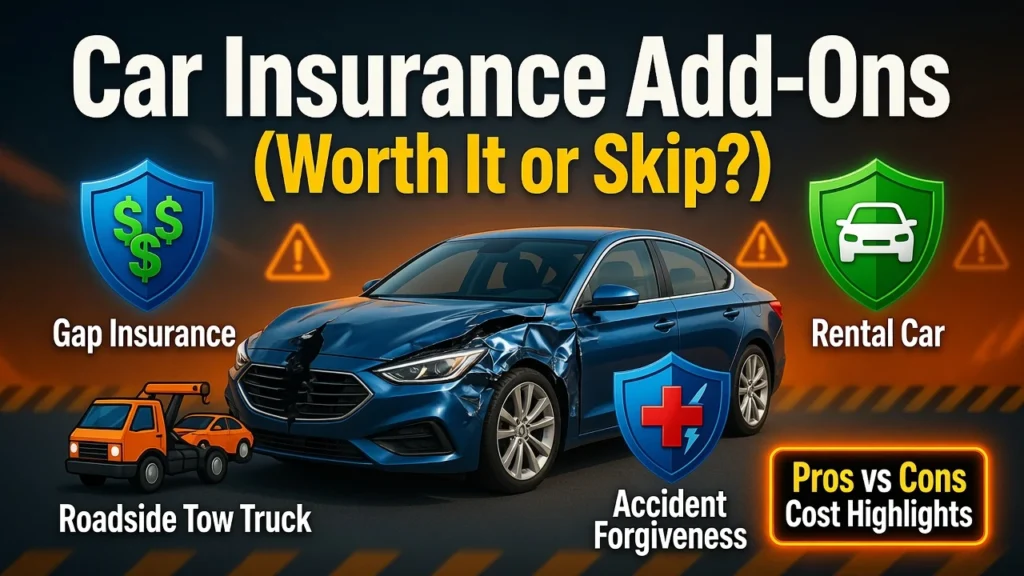
Last winter my brother-in-law’s car got sideswiped in a grocery store parking lot. Whoever hit him didn’t leave a note — no witness, no plate number, nothing. His policy looked solid on paper: comprehensive coverage, decent liability limits, the works his agent walked him through at signing.
Then the body shop called with the estimate, and there was a catch. His policy covered “like kind and quality” parts — insurance-speak for aftermarket. The genuine hood that actually matched his car’s factory fit cost $380 more, and his policy wouldn’t touch that difference.
That’s the thing about car insurance add-ons nobody explains clearly. A standard policy is built to satisfy legal minimums and cover the big, obvious losses. Everything in between — a rental car while yours sits in a shop, the gap between what you owe and what your totaled car is worth, genuine manufacturer parts — usually needs a separate rider you have to know to ask for.
This guide breaks down which add-ons actually protect you, which ones are mostly margin dressed up as peace of mind, and how to tell the difference before you’re the one calling a body shop.
What Car Insurance Add-Ons Actually Are
An add-on — insurers usually call it an endorsement or a rider — is optional coverage you attach to your base policy for an extra premium. It’s not a separate policy. It’s a modification to the one you already have, closing a specific gap the base terms don’t cover.
Here’s a simple way to think about it. Your base policy answers “who pays if I hurt someone or damage their property” through liability coverage, and, if you carry it, “who pays to fix or replace my own car” through comprehensive and collision. Add-ons answer the narrower questions your base policy quietly skips — what happens to your finances while the car’s in the shop, what happens if you owe more than the car’s worth, whether the shop uses factory parts or the cheaper aftermarket equivalent.
Most add-ons only attach to comprehensive or collision coverage. If you’re running a liability-only or third-party policy — common once a car’s paid off — most of these riders won’t apply to you at all, since there’s no first-party damage coverage for them to modify. It’s worth understanding the real difference between third-party and comprehensive coverage before you start picking add-ons, since half of them are irrelevant until you’ve made that choice first.
Why Insurers Sell Coverage This Way
This isn’t an accident of policy design. It’s pricing strategy.
When you shop for a quote, the number that gets compared across insurers is the headline premium for the base policy. That’s the number aggregator sites sort by, the number your friend mentions when they tell you their rate. So insurers have a strong incentive to keep that number lean and competitive, then offer everything else — the stuff that actually protects you in specific situations — as add-ons priced separately. Understanding how your premium actually gets calculated makes this a lot less mysterious once you see the base rate and the add-ons as two different pricing decisions.
There’s also an underwriting reason add-ons are attractive to insurers: they tend to have narrower, more predictable loss profiles than core liability coverage. A liability claim can involve lawsuits, medical costs, and years of uncertainty before it fully closes. Gap insurance, by contrast, has one clearly defined trigger — the car’s a total loss — and the payout is a calculable difference between two numbers.
Tighter risk, tighter pricing, and usually a better margin per dollar collected. That’s not a criticism. It’s just how the math works, and it’s worth knowing when you’re deciding which add-ons are worth paying insurer prices for versus finding the same protection somewhere else, like a credit card’s rental coverage or a manufacturer’s roadside program.
What These Add-Ons Actually Cost
Prices vary by insurer, state, vehicle, and driving history — and most of the figures below reflect the U.S. market, where this kind of pricing data is published most consistently. Still, the ranges give you a real sense of scale.
Roadside assistance typically runs $10 to $50 a year through an insurer, covering towing, lockouts, and emergency fuel delivery. A standalone auto club membership offering similar (often broader) coverage usually runs $50 to $160 a year. The insurer version is frequently the cheaper way to get the same safety net, assuming you don’t already have something similar through a credit card or your car’s warranty.
Rental reimbursement generally costs $2 to $15 a month, or roughly $25 to $100 a year, depending on the daily and total limits you choose. A policy capped at $30 a day for 20 days behaves very differently than one capped at $50 a day for 30 days, and the price reflects that.
Two More Things To Keep In Mind
Gap insurance bought through your insurer usually runs $20 to $40 a year — the Insurance Information Institute puts the average right around $20. The same coverage bought through a dealership at the point of sale often costs $400 to $700 as a one-time add to your loan, for the exact same protection. This is one of the clearest cases where shopping around actually matters.
New car replacement coverage typically adds 5% to 20% to your comprehensive and collision premium, but pays out the full replacement cost of a new equivalent vehicle instead of the depreciated cash value your standard policy would pay. It’s usually only available on cars under one to three years old, often with a mileage cap around 15,000 miles.
Insurance companies sometimes bundle accident forgiveness for free after a few claim-free years, or they charge a modest fee otherwise. Without it, a first at-fault accident commonly raises premiums somewhere between 20% and 50%, sometimes more, depending on your state and insurer — which is exactly why it’s worth planning for this before your rate actually jumps rather than after.
Rideshare or delivery driving coverage runs roughly $6 to $30 a month, filling the gap most personal policies leave wide open the moment you turn on a driving app.
Smart Strategies for Choosing Add-Ons
Match add-ons to your car’s actual finances, not its sticker price. Gap insurance and new car replacement only make sense while you owe more on the car than it’s worth, or while a depreciated payout would be a real financial hit. Once the loan’s paid down, both are usually pure cost with no real benefit — drivers holding onto older, paid-off cars can often drop them entirely and redirect that money elsewhere.
Check for coverage you’re already paying for somewhere else. Plenty of premium credit cards include rental car coverage, and several manufacturers bundle a few years of roadside assistance into a new car purchase. When you pay your insurer for the same thing again, you spend money on redundancy, not protection.
Get accident forgiveness before you need it, not after. Insurers won’t sell you this add-on retroactively; it has to be in place before an at-fault accident happens. If you’re a generally careful driver who’s just had a lucky streak, the annual cost is small insurance against a rate hike that can follow you for three to five years.
Bundle add-ons with one insurer instead of piecing coverage together from multiple providers. Insurers frequently discount a package of endorsements more than they’d ever discount if you called around negotiating each one separately. Comparing full quotes rather than base premiums alone is the only way to actually see this.
Reassess every renewal, not just at purchase. Your needs change—you pay off your car, stop driving for a delivery app, or move somewhere with reliable transit. Add-ons chosen three years ago rarely still match your situation, and insurers won’t proactively tell you to drop something you no longer need.
Pros and Cons of Car Insurance Add-Ons
Pros:
- They close specific, predictable gaps. Instead of hoping your base policy happens to cover an unusual situation, add-ons let you pay for exactly the protection you’re likely to need.
- They’re often cheaper through your insurer than the alternative. Gap insurance is the clearest example — the same protection costs a fraction through an insurer compared to a dealership add-on.
- They’re flexible. You can add or drop most of them at renewal as circumstances change, unlike your base liability limits, which usually can’t dip below your state’s legal minimum.
- They can prevent a single bad event from becoming a long-term financial problem. A totaled, financed car without gap insurance can leave you paying for a car you no longer have.
Cons:
- Stacking too many erases the “cheap base rate” advantage that made the policy attractive in the first place. A policy with a low headline premium and six add-ons can end up costing more than a straightforward mid-priced policy with broader coverage built in.
- Some genuinely overlap with coverage you have elsewhere — through a credit card, an employer benefit, or a manufacturer program — making them redundant rather than protective.
- Pricing isn’t always transparent across insurers, which makes true comparison harder than comparing base premiums. This is one of the most common ways a car insurance bill quietly grows over time.
- Eligibility windows exist. New car replacement, for instance, is often only available while a car is under a certain age or mileage. You can’t always add it later just because you change your mind.
A Real-World Comparison: Two Drivers, One Accident
Here’s a scenario that plays out constantly, and the numbers make the case better than general advice could.
Two drivers, similar cars. Both financed a $28,000 vehicle two years ago with a $3,000 down payment, and both still owe roughly $22,000 on their loans. Their cars, after two years of normal depreciation, are now worth about $19,000. Both cars get totaled in the same month in unrelated accidents.
Driver A added gap insurance at signing, at roughly $30 a year — $60 total over two years. Driver B skipped it to save the $60.
The insurer pays out the car’s actual cash value in both cases: $19,000. For Driver A, gap insurance covers the $3,000 difference between that payout and the remaining loan balance. Driver A walks away owing nothing on a car that no longer exists.
Driver B owes the full $3,000 difference immediately, out of pocket, on a car they can no longer drive, while also needing a down payment for a replacement. That $60 in “savings” turned into a $3,000 bill at the worst possible time.
This is exactly the kind of math that’s easy to skip past when you’re clicking through a quote page trying to reach the lowest possible number, and exactly the kind of math insurers are counting on you not doing.
Add-On Comparison at a Glance
| Add-On | Average Cost Impact | Benefit | Risk Level If Skipped |
|---|---|---|---|
| Roadside Assistance | $10–$50/year | Towing, lockouts, fuel delivery | Low–Medium |
| Rental Reimbursement | $25–$100/year | Replacement car during repairs | Medium |
| Gap Insurance | $20–$40/year | Covers loan-vs-value gap on a total loss | High (if financed) |
| New Car Replacement | +5–20% of premium | Full replacement vs. depreciated payout | Medium |
| Accident Forgiveness | Often low/no extra fee | First at-fault accident doesn’t raise your rate | Medium |
| Rideshare/Delivery Coverage | $6–$30/month | Covers gaps in personal coverage while driving for apps | High (for gig drivers) |
| Custom Parts Coverage | Scales with declared value | Covers aftermarket mods and accessories | High (if heavily modified) |
What Most Drivers Don’t Know Until They Need To
A few things become obvious only once you’ve actually read the fine print or gone through a claim.
Most standard comprehensive policies default to “like kind and quality” parts — industry language for aftermarket parts that fit and function but aren’t made by your car’s manufacturer. Unless you’ve specifically added OEM parts coverage, that’s what a body shop will install after a claim, and it’s part of why some claims end in disputes the driver never saw coming.
New car replacement almost always has an eligibility window, often one to three years from purchase with a mileage cap around 15,000 miles. You generally can’t wait and add it once the “new car” feeling has worn off; by the time you think of it, you’re usually already ineligible.
Add-on pricing tends to get less regulatory scrutiny than core liability rates in many places, since it’s optional and not tied to legally required minimums. That gives insurers more room to price it however the market will bear — which is exactly why it’s worth comparing what a few different insurers actually charge for the same add-on rather than accepting whatever your current one offers, since it can turn up meaningful savings on the add-on side even when your base premium barely moves.
Accident forgiveness protects your rate, not your record. Depending on where you live, the accident may still show up on your driving record or get reported to future insurers. Forgiveness just means your current insurer won’t use it against your price this time.
Who Actually Needs These Add-Ons
Worth serious consideration if you:
- Financed or leased your car within the last two to three years and still owe close to (or more than) it’s worth. Gap insurance and new car replacement earn their cost here.
- Rely on a single car with no backup transportation. Rental reimbursement matters more the fewer alternatives you have.
- Drive for Uber, Lyft, DoorDash, or similar apps. Rideshare coverage isn’t really optional, since most personal policies simply exclude what happens while the app is on.
- Have modified your car with aftermarket parts, a stereo system, wheels, or a lift kit. Standard coverage usually caps payout on mods well below what you actually spent.
- Are a newer driver still building a clean record or otherwise sit in your insurer’s higher-risk pricing bracket, where accident forgiveness offers real downside protection.
Probably fine to skip if you:
- Own your car outright and it’s worth a modest amount. Gap insurance and new car replacement have nothing left to protect at that point.
- Already have rental coverage through a credit card or roadside assistance through a manufacturer warranty or auto club.
- Drive infrequently or have easy access to public transit, which reduces how much a missing rental car would actually cost you.
Frequently Asked Questions
Are car insurance add-ons worth the extra cost? It depends entirely on your situation. Gap insurance is almost always worth it on a financed car; the same coverage on a paid-off, ten-year-old car is close to pointless. Match the add-on to your actual financial exposure rather than following a blanket rule.
Can I add these after I’ve already bought my policy? Most can be added at any renewal, or even mid-term with a call to your insurer. A few, like new car replacement, have eligibility windows tied to your car’s age, so they’re not always available later.
Do add-ons work with third-party or liability-only insurance? Mostly no. Most add-ons modify comprehensive or collision coverage, so on a liability-only policy, most of these riders won’t apply until you add broader coverage first.
What’s the difference between an add-on and a discount? A discount lowers your existing premium based on factors like a clean driving record or bundling policies. An add-on increases your premium in exchange for additional coverage — they move in opposite directions on your bill. It’s worth checking which discounts you might already qualify for before assuming an add-on is your only option.
Can an insurer refuse to sell me a specific add-on? Yes. Eligibility often depends on your car’s age, mileage, or your claims history. Two most commonly restricted are new car replacement and accident forgiveness.
Do add-ons renew automatically every year? Usually, yes, as part of your policy renewal, which is exactly why it’s worth reviewing them annually instead of assuming last year’s choices still make sense.
Will removing an add-on lower my premium right away? In most cases, yes, at your next renewal or billing cycle, though some insurers require you to wait for the full renewal date rather than adjusting mid-term.
The Bottom Line
Add-ons aren’t a scam, and they’re not a must-have checklist either. They’re a set of tools, and the right combination depends entirely on what you drive, how you drive it, and what you’d actually lose if things went wrong.
The mistake most drivers make isn’t picking the wrong add-ons. It’s never sitting down to figure out which gaps in their coverage actually matter to their situation in the first place.
Start with the ones tied to real financial exposure: gap insurance on a financed car, rideshare coverage if you drive for an app, custom parts coverage if you’ve modified your vehicle. Skip the ones duplicating protection you already have somewhere else. And revisit the list every renewal, because the add-ons that made sense when you drove off the lot rarely make sense five years later.
If you haven’t shopped your policy in a while, this step-by-step guide to finding cheaper coverage is a good next move, because the base premium and the add-ons both deserve a second look, not just one of them.
Coverage names, availability, and pricing for these add-ons vary by insurer, state, and country, so confirm the specifics with your provider before assuming any figure above applies exactly to your policy.

**Moon Awan** is the founder of MotoPolicy and a research-driven content creator focused on insurance and financial protection topics. With a strong background in building structured digital platforms, he specializes in analyzing and presenting complex insurance information in a clear and practical way.
At MotoPolicy, his work focuses on areas such as car insurance, health insurance, and policy comparison strategies. He continuously studies insurance trends, coverage structures, and pricing models to provide accurate and up-to-date insights that help readers make informed decisions.
His approach combines technical precision with in-depth research, ensuring that every article is well-organized, easy to understand, and useful for real-world applications.
Through MotoPolicy, his goal is to build a trusted resource where users can confidently learn about insurance, compare options, and improve their financial awareness.
While all content is carefully researched, readers are encouraged to consult licensed professionals for personalized insurance advice.



Pingback: Gap Insurance Explained: Do You Actually Need It in 2026? - MotoPolicyHub