
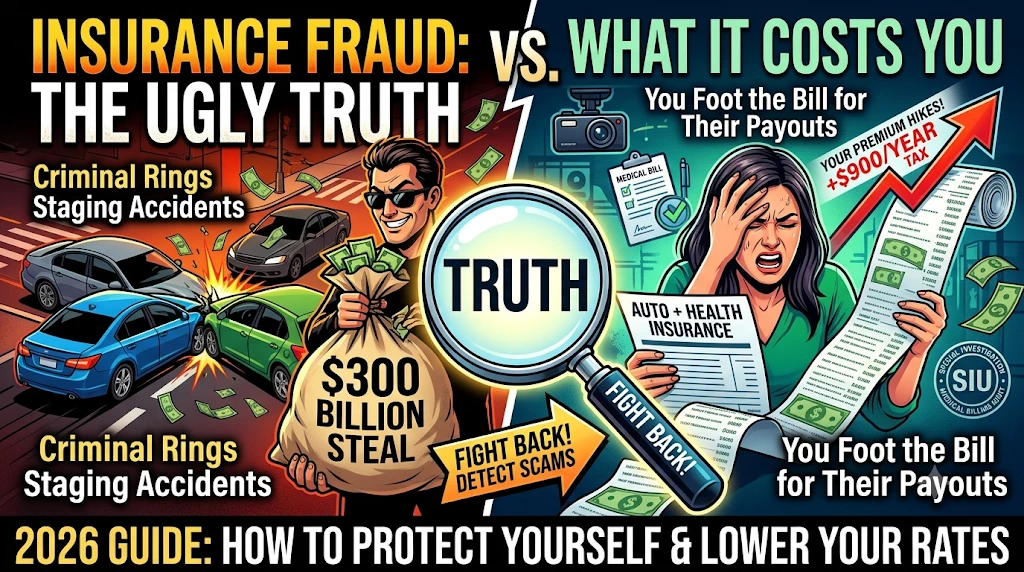
I will never forget the day I got rear-ended at a remarkably slow speed at a red light. The damage was basically a scratched bumper. Yet, within three minutes, a tow truck I never called magically appeared, and the driver of the other car immediately started complaining of severe neck pain, clutching a neck brace that he somehow had sitting in his passenger seat.
I didn’t know it at the time, but I was the victim of a staged accident. Back then, I was still treating my policy like a basic necessity, functioning on a what is insurance a beginners guide level of knowledge. I assumed my insurer would just handle it. They did, but the investigation took months, and it opened my eyes to a massive, hidden economy that drains billions from honest people every single year.
Insurance fraud isn’t just an industry problem; it is a you problem. When criminal rings or even regular folks cheat the system, the financial burden gets passed directly to us through brutal premium hikes. Let me take you behind the curtain to show you exactly how scammers operate, how insurers fight back, and what you need to do to avoid getting caught in the crossfire.
What This Really Means
When we talk about insurance fraud, we aren’t just talking about organized crime syndicates burning down warehouses. Fraud generally splits into two categories, and you might be surprised to learn that regular, law-abiding citizens commit the second type every single day.
1. Hard Fraud (The Criminal Rings)
This involves someone deliberately manufacturing a loss. Think of staged car crashes, faking a death for life insurance, or clinics inventing ghost patients to bill health insurers for surgeries that never happened. These are calculated, criminal enterprises. You might think having full coverage car insurance what does it really mean protects you entirely, but if a scammer targets your vehicle, your clean driving record is suddenly under threat.
2. Soft Fraud (The Everyday Lies)
Soft fraud is opportunistic. It happens when someone who has a legitimate claim exaggerates the damage to get a bigger payout. But it also includes application fraud. For example, a father listing himself as the primary driver on a car that his teenage son drives every day. He does this to get cheaper car insurance for young drivers, but this is an illegal practice called “fronting.” Similarly, buying a policy with bogus information, like seeking out no deposit car insurance using a fake address to get a lower regional rate, is soft fraud.
Why This Happens
Why is insurance fraud so rampant? The short answer is the psychology of the “victimless crime” combined with massive pools of corporate money.
People view insurance companies as bottomless wallets. Because folks pay premiums for years without filing a claim, they feel “owed” a payout when something finally happens. If you understand how insurance companies make money, you know that insurers rely on risk pooling. They collect premiums from the many to pay for the losses of the few.
When fraudsters drain that pool, the math changes. Insurers don’t just eat those losses; they recalculate their risk models. Every staged crash and every exaggerated whiplash claim acts as a variable in how car insurance premium is calculated. In short, the criminals get the payout, the insurer gets their margins back through rate hikes, and you foot the bill.
Real Data & Cost Breakdown
Let’s look at the actual numbers, because the scale of this problem is staggering. The Coalition Against Insurance Fraud estimates that fraud steals over $300 billion a year across all insurance sectors in the US alone.
Here is how that breaks down for the average consumer:
- The Family Tax: Fraud adds roughly $400 to $900 per year to the average family’s insurance costs.
- Health Insurance Drain: Fraudulent medical billing costs tens of billions. Shady clinics push unnecessary tests, drastically inflating what health insurance actually covers.
- Premium Spikes: Falling victim to a staged auto accident can cause your rates to jump by 20% to 40% at renewal.
Failing to recognize the signs of a scam is one of the top mistakes that increase your car insurance cost. Furthermore, if an insurer suspects you of soft fraud (even accidental misrepresentation), they will void your policy. This is exactly why insurance claims get rejected when people need them the most.
Smart Strategies That Work
Protecting yourself requires a mix of common sense and documentation. Here are the strategies I use and recommend.
1. Install a Dashcam (Impact: High)
A $50 dashcam is your ultimate defense against a staged accident. Scammers rely on a “he said, she said” scenario. When you tell an aggressive fraudster, “We can wait for the police, I have it all on video,” they will often panic and flee. When figuring out how to claim car insurance easily, video evidence bypasses months of investigation. Plus, having a dashcam can sometimes qualify you for hidden car insurance discounts.
2. Audit Your Medical Bills (Impact: Medium to High)
Medical identity theft is real. Someone might steal your policy info to get treatments. Every time you file a health insurance claim step by step, wait for your Explanation of Benefits (EOB) document. Read it carefully. Did you actually get that MRI? Did the doctor really spend 60 minutes with you, or just 10? If something is wrong, report it immediately.
3. Use Reputable Comparison Sites (Impact: High)
“Ghost brokers” are scammers who pose as agents, sell you a fake policy, and pocket the cash. When you want to compare car insurance quotes online without losing your mind, always use verified, national comparison platforms. If a deal from a random Facebook ad looks too good to be true, it is.
Pros and Cons of Anti-Fraud Measures
To combat fraud, insurers have introduced new tech. Here is how engaging with these measures impacts you:
- Pro – Unbiased Evidence: Using telematics programs (where an app tracks your driving) proves exactly how fast you were going and when you braked. If you use pay per mile car insurance, the insurer already has GPS data validating your location.
- Pro – Better Rates: Fighting fraud stabilizes the market. Agreeing to tight, automated payment schedules—like choosing between monthly vs annual car insurance via direct debit—prevents scammers from executing “cancel and run” schemes, which lowers administrative costs for everyone.
- Con – Privacy Sacrifices: Dashcams and telematics apps track your exact movements, which some drivers find invasive.
- Con – False Flags: Sometimes innocent mistakes on an application trigger fraud alerts, causing annoying delays in coverage.
Real-Life Scenario: The “Swoop and Squat”
Let’s talk about a classic fraud tactic. Imagine you are driving on a moderately busy street. A car pulls up alongside you (the “Swoop”), preventing you from changing lanes. Suddenly, the car in front of you (the “Squat”) slams on its brakes for absolutely no reason. You rear-end the Squat vehicle.
Legally, the driver who rear-ends another car is almost always found at fault. The passengers in the Squat car will immediately claim severe back and neck injuries. They will visit a crooked chiropractor who inflates the medical bills to $25,000.
The Aftermath:
Without a dashcam, you are found 100% at fault. Your insurer pays out the $25,000. Now, your rates skyrocket. You are forced to figure out how to lower car insurance after an accident, but your current provider drops you. You are suddenly thrust into the non-standard market, lumped in with car insurance for high-risk drivers. Over the next three years, this single staged accident will cost you an extra $3,500 in premium increases.
This is exactly why accepting a settlement on the street or failing to call the police is a massive health insurance mistake (and auto mistake). Always get an official police report.
Comparison Table: Types of Fraud
| Fraud Tactic | Average Cost Impact (to Insurer) | Benefit to Scammer | Your Risk Level | How to Defend |
| Swoop & Squat (Staged) | $20k – $50k+ | Massive injury payouts | High (Targeted on roads) | Dashcam, Call Police |
| Phantom Medical Billing | $500 – $10,000 | Cash for no services rendered | Medium (Data theft) | Audit EOBs closely |
| Ghost Brokering | $1k – $3k (Your money) | Stolen premium cash | Low (If you verify agents) | Buy direct/verified |
| Fronting (Soft Fraud) | Denied Claims ($10k+) | Temporary lower premium | Extremely High (Policy voided) | Always tell the truth |
Expert Insights: How Insurers Fight Back
You might think insurers are asleep at the wheel, but they employ aggressive countermeasures. Every major carrier has a Special Investigations Unit (SIU) staffed by former law enforcement officers and data scientists.
The top 10 insurance companies in the world now use AI and machine learning to flag claims before human eyes even see them. If a claim is filed within 30 days of a policy inception, the AI flags it. If the digital footprints of two “strangers” in an accident show they are Facebook friends, the AI flags it.
Furthermore, carriers share data via massive databases like the ISO ClaimSearch. If John Doe claims whiplash in Florida with Company A, and then claims whiplash in Texas six months later with Company B, the database catches it. This data sharing is crucial, whether we are talking about third-party vs comprehensive car insurance; the underlying claimant history is fully transparent to the industry.
Who is Most Vulnerable to Fraud?
Scammers do not target people randomly. They look for specific vulnerabilities:
- New Residents & Expats: Criminals target people who are unfamiliar with local laws, especially those trying to figure out if car insurance is mandatory country-wise.
- Young Students: College kids are prime targets for ghost brokers offering absurdly cheap health insurance for students via Instagram. The policy turns out to be fake.
- Used Car Buyers: Scammers sell stolen or flooded vehicles with “washed” titles. When you go to secure the best car insurance for used cars, the carrier flags the VIN as totaled, leaving you without a car and out thousands of dollars.
FAQs
Q: How can I find legitimate coverage without getting scammed by a ghost broker?
A: Stick to authorized channels. Follow a proven guide to get cheap car insurance step by step, and only finalize purchases directly on the official websites of the best car insurance companies in 2026. Always double-check the URL to ensure you are getting real insurance quotes online.
Q: I suspect a mechanic is inflating the damage for an insurance payout. What do I do?
A: Demand a detailed, itemized estimate. Some shady shops will try to bill your carrier for car insurance add-ons you didn’t approve, like premium rental car upgrades you didn’t use. Take your car to an insurer-approved network shop instead.
Q: Is medical identity theft a big deal if I have a good family plan?
A: Yes, it is massive. Once you choose the right health insurance plan, protect your policy number like a Social Security number. Scammers will aggressively bill the best health insurance plans for families because the coverage limits are higher.
Q: Does healthcare fraud only happen with private companies?
A: Not at all. If you look at the private vs public health insurance systems, massive schemes hit government programs like Medicare/Medicaid just as hard as private carriers.
Q: What if I accidentally miss a payment, will they think I’m running a scam?
A: Insurers understand honest mistakes, but repeated lapses look highly suspicious. Knowing what happens if you miss a car insurance payment is critical; usually, you get a short grace period before your policy cancels, but do not let it become a habit.
Q: Is GAP insurance vulnerable to fraud?
A: Dealerships sometimes heavily inflate the price of GAP coverage during the finance phase, misrepresenting what gap insurance actually covers. Always buy it directly from your insurer, not the car dealer.
Q: If I find incredibly cheap health coverage on a forum, is it safe?
A: Almost never. While it is possible to find the cheapest health insurance plans with good coverage, they need to come from licensed state or federal marketplaces, not random social media links.
The Bottom Line
Insurance fraud is a hidden tax on your daily life. Whether it is a highly organized crime syndicate running a staged accident ring, or just a neighbor lying about where they park their car at night, every fraudulent dollar paid out comes directly from your wallet in the form of higher premiums.
You cannot control what criminals do, but you can build a fortress around your own finances. Buy a dashcam today—it is the best $50 you will ever spend. Audit every single medical bill that comes through your mailbox, and never sign a blank document at a mechanic’s shop or doctor’s office. Treat your policy numbers with the same extreme caution as your bank passwords. Stay alert, stay honest on your applications, and do not let scammers turn your safety net into their personal ATM.

**Moon Awan** is the founder of MotoPolicy and a research-driven content creator focused on insurance and financial protection topics. With a strong background in building structured digital platforms, he specializes in analyzing and presenting complex insurance information in a clear and practical way.
At MotoPolicy, his work focuses on areas such as car insurance, health insurance, and policy comparison strategies. He continuously studies insurance trends, coverage structures, and pricing models to provide accurate and up-to-date insights that help readers make informed decisions.
His approach combines technical precision with in-depth research, ensuring that every article is well-organized, easy to understand, and useful for real-world applications.
Through MotoPolicy, his goal is to build a trusted resource where users can confidently learn about insurance, compare options, and improve their financial awareness.
While all content is carefully researched, readers are encouraged to consult licensed professionals for personalized insurance advice.



