
I still remember staring at my first real policy document, completely lost in a sea of legal jargon. I thought a “deductible” meant the amount the insurance company deducted from my final hospital bill. Spoiler alert: it means the exact opposite. It’s the amount they deduct from their payout, meaning I had to pay it out of my own pocket.
That single misunderstanding cost me a cool $1,000 because I didn’t know how to navigate the basic foundations of what insurance actually is. It’s a harsh reality, but avoiding the top health insurance mistakes usually starts with simply understanding the vocabulary.
If you’ve ever felt like insurance companies are speaking a foreign language designed to confuse you, you aren’t crazy. They are. But learning this language is the ultimate financial cheat code. Once you understand the mechanics behind the terminology, you stop overpaying for coverage you don’t need and stop getting blind-sided by hidden costs when you actually have to use your policy.
Let’s decode this industry piece by piece.
Section 1: What This Really Means
Before we look at how to save money, we have to translate the core terminology. Think of your insurance policy as a subscription box for financial protection. You pay a fee, and in return, the company promises to catch you if you fall—under very specific conditions.
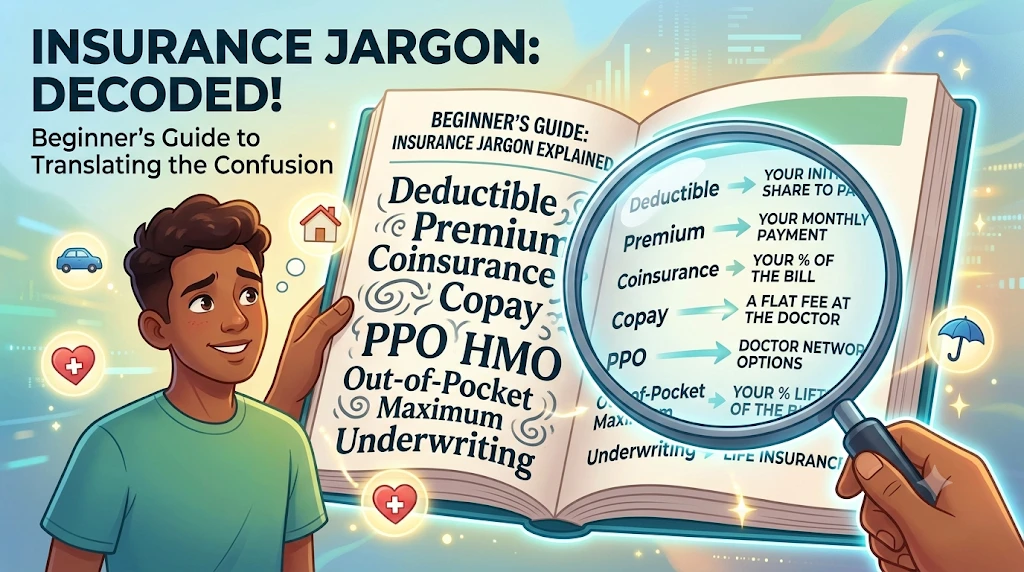
Premium: This is your subscription fee. It’s the amount you pay out of pocket just to keep the policy active.
Deductible: Your “skin in the game.” If you crash your car and the damage is $5,000, but your deductible is $1,000, you pay the first $1,000. The insurer covers the remaining $4,000.
Co-Pay & Co-Insurance: Mostly found in medical policies. A co-pay is a flat fee (like paying $30 to see a doctor). Co-insurance is a percentage (like paying 20% of an X-ray bill). If you are trying to understand what health insurance actually covers, looking at these two numbers is your starting point.
Limits/Coverage Caps: The absolute maximum the company will pay out.
Endorsements/Riders: These are car insurance add-ons or policy upgrades. Standard policies are one-size-fits-all. Riders customize them.
Specific Coverage Types:
People often throw around terms like “full coverage,” but the reality is much more granular. Understanding what full coverage car insurance actually means usually reveals it’s just a mix of Liability (paying for the other guy’s car) and Collision/Comprehensive (paying for yours). Deciding between third-party vs comprehensive coverage is where you make your biggest financial decisions. And if you finance a brand-new vehicle, you’ll quickly need to learn what gap insurance actually covers so you don’t end up owing a bank $5,000 for a totaled car.
Section 2: Why This Happens
Why do insurers make it so complex? It boils down to legal precision and actuarial science. When you look at how insurance companies actually make money, their entire business model relies on “risk pooling.”
They collect premiums from thousands of people, knowing only a handful will file claims. To protect their profit margins, they employ actuaries—math wizards who predict the probability of you crashing your car or breaking your leg.
If you’ve ever wondered how your car insurance premium is calculated, it’s all about categorizing your risk. They use jargon and strict definitions to mitigate “moral hazard.” If policies had zero deductibles and covered everything without limits, people would be careless. Deductibles force you to share the financial pain of an accident, making you a safer driver or a more cautious patient.
Every confusing term in your contract is a carefully calculated boundary designed to keep the insurer’s loss ratio (the amount they pay out versus what they take in) strictly profitable.
Section 3: Real Data & Cost Breakdown
Let’s look at how understanding these terms translates to real dollars. By simply tweaking the jargon in your favor, the savings are massive.
- The Deductible Lever: Raising an auto deductible from $250 to $1,000 typically reduces your premium by 15% to 25%. If you pay $1,500 a year, that’s up to $375 in annual savings. If you go three years without an accident, you’ve saved $1,125—which covers the higher deductible if you eventually need it.
- Payment Frequency: Did you know insurers charge you a “convenience fee” for paying monthly? Understanding the math behind monthly vs annual car insurance payments shows that paying a lump sum annually can save you between 5% and 10% instantly.
- Target Demographics: If you’re 19 years old, actuaries view you as a walking liability. Finding the right car insurance for young drivers is tough, but young drivers who opt for a higher deductible and a telematics (tracking) program often see quotes drop by up to 30%.
- Health Plan Realities: Finding the cheapest health insurance plans with good coverage usually means accepting a high deductible. However, if your employer offers a Health Savings Account (HSA) to pair with it, the tax advantages often outweigh the higher out-of-pocket costs.
- Provider Reputation: Keep in mind, a cheap premium is useless if the company won’t pay out. Always cross-reference your quotes with the best car insurance companies currently operating to ensure you aren’t trading quality for a low upfront price.
Section 4: Smart Strategies That Work
Now that you know the language, you can play the game. Here are the strategies I use, complete with the “why” and the expected impact.
1. Aggressive Quote Comparison
Never accept your renewal price blindly. When you learn how to compare car insurance quotes online, you force insurers to compete for your business.
- Why it works: Algorithms penalize loyalty. New customers get the best rates.
- Impact: Comparing 3–5 quotes can lead to a 15–20% reduction. It is the core strategy for getting cheap car insurance step-by-step. Similarly, gathering several insurance quotes online protects you from predatory pricing.
2. Hunt for Hidden Discounts
Most people leave money on the table. Ask your agent about obscure car insurance discounts like defensive driving courses, alumni associations, or even parking in a garage.
- Why it works: Actuaries have proven that people in certain groups file fewer claims.
- Impact: Stacking discounts can shave 10–15% off your premium, neutralizing many common mistakes that increase your costs.
3. Switch to Usage-Based Insurance
If you work from home or drive less than 10,000 miles a year, traditional policies are a rip-off. I slashed my bills dramatically when I transitioned to a pay-per-mile insurance model.
- Why it works: You aren’t subsidizing people who commute two hours a day.
- Impact: Low-mileage drivers often save 30–40%.
4. Damage Control Post-Accident
If you have a claim on your record, you will face surcharges. Implementing strategies to lower your car insurance after an accident (like taking a certified safe-driving course) is critical.
- Why it works: It proves to the algorithm that you are actively lowering your risk profile.
- Impact: Can reduce post-accident premium spikes by up to 10%.
5. Match Coverage to the Asset
When figuring out how to choose the right health insurance plan, you match the plan to your health status. If you are young and healthy, take the high deductible. If you have chronic conditions, pay the higher premium for lower co-pays.
Section 5: Pros and Cons
Understanding insurance jargon completely shifts your power dynamic with brokers.
Pros of Mastering the Terminology:
- You spot the upsell: You know when a broker is pushing a useless rider.
- Accurate cost-benefit analysis: You can mathematically calculate if a higher deductible is worth the premium drop.
- Better medical choices: You understand the difference in networks, an essential skill when weighing private vs public health insurance options.
Cons (The Challenges):
- Time-consuming: Reading the fine print takes patience.
- Information overload: Policies change annually, meaning you have to re-evaluate your understanding constantly.
- Overconfidence risk: Thinking you know everything might lead you to drop vital coverage just to save a few dollars.
Section 6: Real-Life Scenario
Let’s look at a scenario I went through two years ago. I bought a 2015 Honda Civic for $8,000. I initially slapped my standard “full coverage” policy on it. My premium was $1,200 a year, with a $500 deductible.
Then I looked at the actual math and the best ways to insure a used car. If I totaled the car, the insurer would pay me the actual cash value ($8,000) minus my deductible ($500). Best case scenario, I get $7,500.
But I was paying nearly $500 a year just for the collision portion of my premium. In three years, I’d pay $1,500 to protect a depreciating $7,500 asset. I dropped the collision coverage entirely, kept the liability high, and put that $500 a year into a high-yield savings account. I self-insured the physical damage of my car and saved money doing it.
Section 7: Comparison Table
To make this incredibly clear, here is how tweaking specific policy terms impacts your wallet.
| Policy Component | Average Cost Impact | Benefit | Risk Level |
| Low Deductible ($250) | Premium is 20% higher | Minimal out-of-pocket cost during a claim | Low (Predictable expenses) |
| High Deductible ($1,000+) | Premium drops 15-25% | Massive annual savings | High (Must have emergency cash) |
| Low Co-Pay Health Plan | Very High Monthly Premium | Cheap doctor visits & prescriptions | Low (Great for chronic conditions) |
| High Out-of-Pocket Max | Very Low Monthly Premium | Protects against total bankruptcy only | Very High (Terrible if you get sick) |
Section 8: Expert Insights
Beyond the basic terms, there are hidden industry mechanics that trip people up.
Subrogation: This is a fancy term meaning your insurance company has the right to sue the at-fault party to get their money back. If someone rear-ends you, your company might pay your medical bills upfront, but they will aggressively go after the other driver’s insurer to recoup that cash.
Rescission & Fraud: Insurers actively look for reasons to cancel policies if they suspect lying. Misrepresenting your address to get a cheaper rate isn’t clever; it’s a crime. Understanding the ugly truth about insurance fraud reveals that “soft fraud” is the number one reason people end up blacklisted.
The Claims Denial Trap: If you don’t understand your policy exclusions, you will face rejections. Reading up on real cases of why insurance claims get rejected shows that 80% of denials happen because the customer assumed a specific scenario was covered when the jargon explicitly excluded it.
Global Nuances: Keep in mind that insurance rules aren’t universal. If you travel or relocate, you’ll find that mandatory car insurance laws vary wildly by country. The players change too; the top 10 global insurance giants dictate pricing trends worldwide based on regional risk data.
Section 9: Who Should Consider This
Who actually needs to sit down and master these terms?
- Young Adults & Students: If you are transitioning off your parents’ plans, the learning curve is brutal. Navigating health insurance for students requires knowing the difference between an HMO and a PPO to avoid out-of-network fees.
- Heads of Households: Finding the best health insurance plans for families is a balancing act between affordable premiums and out-of-pocket maximums that won’t bankrupt you if your kid breaks an arm.
- Drivers with a Record: If you have tickets or accidents, you are pushed into the non-standard market. Securing car insurance for high-risk drivers demands a deep understanding of SR-22 filings and liability limits.
If you have unlimited wealth and a massive emergency fund, you can afford to ignore the jargon and just buy the most expensive, lowest-deductible policy. For the rest of us, financial literacy is our best defense.
Section 10: FAQs
1. How do I actually file a claim without it turning into a nightmare?
Preparation is key. For autos, taking photos and reading our guide on how to claim car insurance easily streamlines the process. Medical claims require keeping detailed billing codes.
2. Why is medical billing so much harder to process?
Medical policies have complex network tiers. Learning how to file a health insurance claim step-by-step is necessary because doctors often bill out-of-network without telling you, leaving you to fight the insurer for reimbursement.
3. What happens if I miss a premium payment?
There is usually a short grace period (often 10-30 days), but you need to know exactly what happens when you miss a car insurance payment. If the policy lapses, getting reinstated will categorize you as a higher risk, jacking up your future rates.
4. Can I get auto coverage if I don’t have upfront cash?
Some companies advertise “pay later” setups, but investigating if no-deposit car insurance is actually worth it reveals they usually just charge you exceptionally high monthly installments to offset their risk.
5. Does my premium go up immediately after I crash?
No. Your current rate is locked in until your policy renews (usually every 6 or 12 months). The surcharge will hit at your next renewal date.
Conclusion
Insurance is not a scam, but it is a business heavily tilted in favor of the house. The companies bank on the fact that you will get bored reading the paperwork and simply sign on the dotted line.
Taking an hour out of your weekend to define your deductibles, check your coverage limits, and aggressively shop around using the terminology you’ve learned today is the highest hourly rate you will ever earn. You aren’t just buying a piece of paper; you are buying a specific legal contract to protect your net worth. Treat it with the scrutiny it deserves. Dig out your current policy today, find your declaration page, and look at exactly what you are paying for. You might be surprised by how much money you can save by simply speaking their language.



