
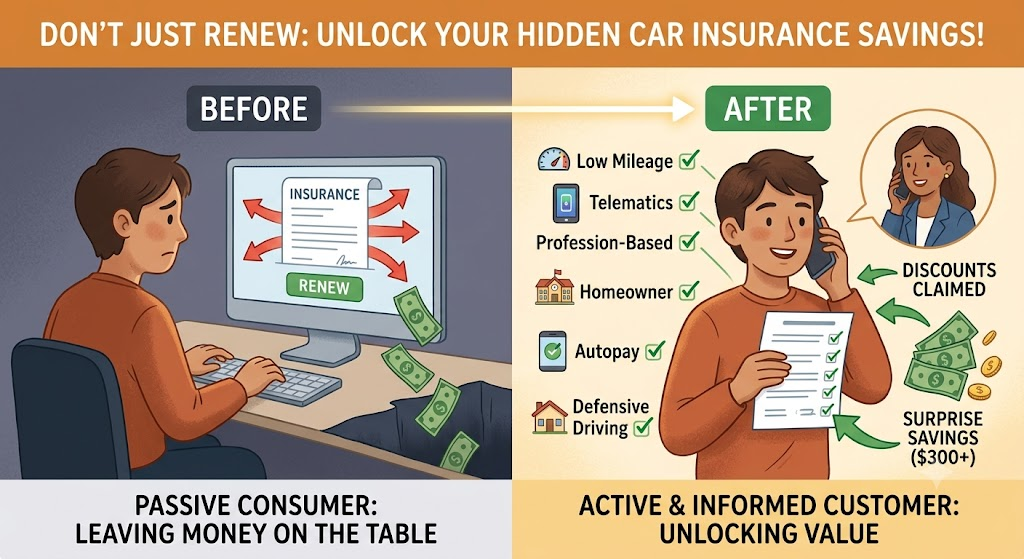
A couple of years ago, I was complaining to a coworker about how expensive my car insurance had gotten. I’d just renewed my policy and it ticked up another $200 for the year — for no obvious reason. No accidents. No tickets. Nothing had changed. My coworker looked at me and said, “Did you ask them about discounts?”
I hadn’t. Not once in six years of being a customer with the same insurer.
Turns out I’d been leaving money on the table the entire time. After one phone call and about 20 minutes of conversation with my insurance rep, I walked away saving over $300 annually. Just by asking the right questions and knowing what to look for.
That conversation changed how I think about car insurance entirely. It’s not just something you set and forget — there’s a whole layer of potential savings most people never dig into because they assume their insurer already gave them the best rate. Spoiler: they probably didn’t.
So here’s everything I’ve learned since then — including some discounts that genuinely surprised me.
The “Just Renewing” Trap
Most of us approach renewal season the same way: the email arrives, we glance at the premium, wince slightly, and click “renew.” Done.
That’s exactly what insurance companies count on.
They rarely volunteer discounts. It’s not their job to proactively lower their own revenue. It’s your job to ask — and to know what to ask about.
I’m not blaming anyone. I did the same thing for years. But once I started treating my insurance renewal the way I treat a hotel rate (i.e., something worth negotiating and checking), the savings started adding up quickly.
Discounts That Actually Exist (And That Most People Miss)
1. The Low Mileage Discount
This one got me. After the pandemic, I was working from home three days a week and driving significantly less than I used to. My insurer had no idea because I never told them.
If you drive under a certain threshold — commonly around 7,500 to 10,000 miles per year, though it varies by insurer — you may qualify for a low mileage discount. Some companies will ask you to verify this annually through your odometer reading. Others use a plug-in device or app to track it.
The key is to report the change. They won’t know unless you say something.
If you’ve changed jobs, started working remotely, moved closer to work, or just generally drive less than you did when you first got your policy — call and update your mileage estimate. It’s a five-minute conversation that can shave a meaningful chunk off your premium.
2. Telematics / Usage-Based Insurance Programs
This one comes with a caveat, but stick with me.
Most major insurers — Progressive (Snapshot), State Farm (Drive Safe & Save), Allstate (Drivewise), GEICO (DriveEasy) — offer telematics programs where you let them monitor your driving through an app or small OBD-II plug-in device. In exchange, they offer a discount based on how well you drive.
I enrolled in my insurer’s version of this and got a 12% discount after the first 90 days. I’m a pretty conservative driver — I don’t brake hard, I don’t speed excessively, I drive during low-risk hours — so it worked in my favor.
The catch: if you drive aggressively, brake late, speed regularly, or drive a lot at night, your data might actually increase your risk profile. Read the fine print. Some programs guarantee you won’t be penalized; others don’t.
If you’re a careful driver, this is one of the most underutilized discounts out there. A lot of people are uncomfortable with the monitoring aspect, which I get — but the apps aren’t doing anything more invasive than what your phone does already.
3. Occupation-Based Discounts
This one floored me when I first heard about it.
Certain professions are statistically associated with lower accident rates, and some insurers offer discounts based on your job. Teachers, nurses, engineers, military personnel, government employees, and scientists are commonly listed as qualifying professions.
I’m a software developer. When I switched insurers a few years back, the agent asked about my job, typed something in, and told me I qualified for a “professional discount.” I didn’t even have to push for it — but I also had no idea it existed until she mentioned it.
If your insurer doesn’t offer profession-based discounts, ask about membership-based ones. Alumni associations, professional organizations (like IEEE, AICPA, or nursing associations), credit unions, and AAA memberships often come with negotiated group insurance rates.
4. The Homeowner Discount (Even If You’re Not Bundling)
Everyone knows about bundling your home and auto — but fewer people know that simply being a homeowner can get you a discount on your car insurance, even if your home is insured elsewhere.
The logic from the insurer’s side: homeowners tend to be more financially stable and statistically less likely to let policies lapse. Whether you agree with that reasoning or not, the discount is real.
If you bought a house in the last few years and never updated your profile with your insurance company, it’s worth mentioning. Same goes if you recently went from renting to owning.
5. Paperless and Autopay Discounts
Tiny, but real. Most insurers will knock 3–7% off your premium if you go paperless (electronic statements and documents) and another small percentage if you set up automatic payments.
These are the kinds of micro-discounts that add up without requiring any behavioral change on your part. You were probably going to pay online anyway. Might as well get something for it.
6. Loyalty Discounts (And When They Actually Work Against You)
Here’s where things get a little murky.
Some insurers offer loyalty discounts for customers who have been with them for multiple years. On paper, that sounds great. In practice, these loyalty discounts are often smaller than the savings you’d get by shopping around.
I stayed with the same insurer for six years partly because I assumed loyalty was rewarded. When I finally compared quotes, I found a competitor offering a significantly lower rate for the same coverage — not because they were better, but because they just wanted my business.
The lesson: loyalty discounts exist, but they don’t always keep pace with the new-customer rates competitors are willing to offer. Use them as one factor, not the only factor. Check rates elsewhere every two or three years. The comparison doesn’t have to take long.
7. Defensive Driving Course Discount
This is one of the most overlooked discounts for adults over 25.
Taking an approved defensive driving course — many of which are now available online through platforms like iDriveSafely or the National Safety Council’s defensive driving program — can qualify you for a discount ranging from 5% to 15% depending on your state and insurer.
The courses typically take 4–6 hours and cost between $25 and $50. If your annual premium is $1,200, a 10% discount pays back the course cost many times over.
Some states actually mandate that insurers offer this discount. It’s worth calling your insurer to ask which courses they accept before you enroll, just to make sure you pick an eligible one.
8. Good Student Discount
If you have a teenager on your policy (or if you’re a student yourself), this one matters a lot.
Most insurers offer a good student discount for full-time students who maintain a B average or above. The discount can be substantial — sometimes 15–25% — because statistically, students who do well academically tend to be more careful drivers.
You’ll typically need to provide a transcript or a school-issued letter each year to keep the discount active. It’s a small administrative task for potentially significant savings on what is otherwise a very expensive segment of most families’ policies.
9. Multi-Vehicle Discount
Most people know about this one in theory but don’t always apply it. If you and your partner or family members have separate policies with different insurers, there’s a real chance you’re leaving this on the table.
Consolidating multiple vehicles under a single policy (and insurer) typically triggers a multi-vehicle discount that reduces the per-car premium. The math doesn’t always work out — sometimes your specific vehicles or histories make it cheaper to keep them separate — but it’s worth running the comparison.
Call your current insurer, tell them you want to add a vehicle, get a quote for the bundle, and compare that to what you’re paying separately across two policies.
10. Vehicle Safety Feature Discounts
Newer cars are loaded with safety technology: automatic emergency braking, lane departure warnings, blind-spot monitoring, anti-lock brakes, adaptive cruise control. Many insurers will discount your premium if your vehicle has these features because they reduce the likelihood and severity of accidents.
This is especially relevant if you recently bought a new car but set up your new policy by just listing the vehicle without specifically noting the safety features. Some insurers pull this data automatically from VIN lookups; others don’t. It’s worth going through your car’s feature list and asking your insurer if any of them qualify.
Mistakes I Made (So You Don’t Have To)
Mistake #1: Assuming my insurer was tracking my life changes automatically.
They weren’t. When I moved, changed jobs, started working from home, paid off my car loan — none of these got automatically reflected in my profile. Each of these is a trigger worth mentioning to your insurer, because several of them affect your premium.
Mistake #2: Renewing without comparing.
I renewed with the same company for years without getting competing quotes. Tools like The Zebra, NerdWallet’s comparison tool, or even just calling two or three insurers directly make this easier than ever. Comparison takes maybe 30 minutes and can save hundreds.
Mistake #3: Not asking about discounts outright.
Your insurer won’t always volunteer them. I now end every renewal call with: “Is there any discount on my policy I might be eligible for that I’m not currently receiving?” That one question has consistently produced results.
Mistake #4: Choosing a lower deductible by default.
This isn’t a discount per se, but it affects your premium significantly. I had a $250 deductible because I picked it when I was younger and less financially stable. Switching to a $1,000 deductible cut my premium noticeably. If you have an emergency fund, a higher deductible is often the smarter play — you’re essentially self-insuring for smaller claims and paying less for the big-risk coverage.
How to Actually Go After These Discounts: A Simple Approach
You don’t need to do all of this at once. Here’s a practical sequence:
Step 1: Pull out your current policy declarations page. Look at what discounts you’re currently receiving — most policies list them. Note what’s missing.
Step 2: Audit your life changes since your last policy update. New job? New address? Less driving? New car? Pay off your loan? Bought a house? Any of these could trigger new eligibility.
Step 3: Call your insurer (or chat with them online) and walk through the discount list. Ask specifically about: low mileage, professional/occupation discounts, homeowner status, telematics enrollment, defensive driving, paperless/autopay, and any association memberships you hold.
Step 4: Get two or three competing quotes using an aggregator like The Zebra or by calling competitors directly. If you find significantly better rates, call your current insurer back and ask if they can match or beat it. Sometimes they can.
Step 5: Set a reminder to repeat this process at your next renewal. Rates, eligibility, and your own life circumstances all change.
A Note on Telematics Privacy
I want to address this more directly because it comes up a lot.
The monitoring programs I mentioned — Snapshot, Drive Safe & Save, Drivewise, DriveEasy — do collect data about your driving behavior. Depending on the program, this can include location data, speed, braking patterns, and time of day.
Some people are uncomfortable with this and that’s completely valid. If you care about data privacy, read the insurer’s privacy policy carefully before enrolling. Ask specifically: what data is collected, how long is it retained, and can it be shared with third parties or used in ways beyond your premium calculation?
For me personally, the trade-off made sense. But it’s not the right call for everyone, and I wouldn’t suggest enrolling without understanding what you’re agreeing to.
The Bigger Picture
Car insurance is one of those categories where passive consumers pay significantly more than engaged ones — not because they’re being cheated exactly, but because the system rewards people who ask questions, update their information, and shop around.
The discounts are real. They’re not gimmicks. They exist because certain behaviors and characteristics genuinely reduce risk, and the insurer benefits from incentivizing them.
The gap between what a passive customer pays and what an informed customer pays for the same coverage can easily be $300–$600 per year. Over a decade, that’s a meaningful amount of money.
It took me an embarrassingly long time to figure this out. I’m hoping it takes you a lot less.
Have a discount that worked for you that I didn’t mention? Drop it in the comments — I’m always curious what’s working for people in different states and with different insurers.

**Moon Awan** is the founder of MotoPolicy and a research-driven content creator focused on insurance and financial protection topics. With a strong background in building structured digital platforms, he specializes in analyzing and presenting complex insurance information in a clear and practical way.
At MotoPolicy, his work focuses on areas such as car insurance, health insurance, and policy comparison strategies. He continuously studies insurance trends, coverage structures, and pricing models to provide accurate and up-to-date insights that help readers make informed decisions.
His approach combines technical precision with in-depth research, ensuring that every article is well-organized, easy to understand, and useful for real-world applications.
Through MotoPolicy, his goal is to build a trusted resource where users can confidently learn about insurance, compare options, and improve their financial awareness.
While all content is carefully researched, readers are encouraged to consult licensed professionals for personalized insurance advice.


