
Let me tell you about the worst Monday of my life.
I’d just dropped my kid off at school, was heading back home, and stopped at a red light. The car behind me didn’t. A fairly low-speed collision — the other driver was distracted, maybe checking his phone — but enough to crumple my rear bumper and leave me standing on the side of the road at 8:40 AM wondering what the heck I was supposed to do next.
I had insurance. I knew I had insurance. But I’d never actually used it before, and in that moment, I realized I had zero clue where to start. I called my wife. She didn’t know either. I Googled “how to claim car insurance” and got a bunch of overly formal articles that read like legal documents.
So I figured it out mostly on my own, made some mistakes, and eventually got my car repaired. Then, two years later, I had to do it again (different situation — a parking lot hit-and-run). The second time I was faster, calmer, and got a better outcome.
Therefore This guide is what I wish I’d had both times.
First Things First — Don’t Panic at the Scene
I know that sounds obvious, but the first few minutes after an accident feel chaotic. Your heart’s racing, the other driver might be upset, there might be traffic piling up around you. The instinct is to just deal with people and get out of there.
Resist that.
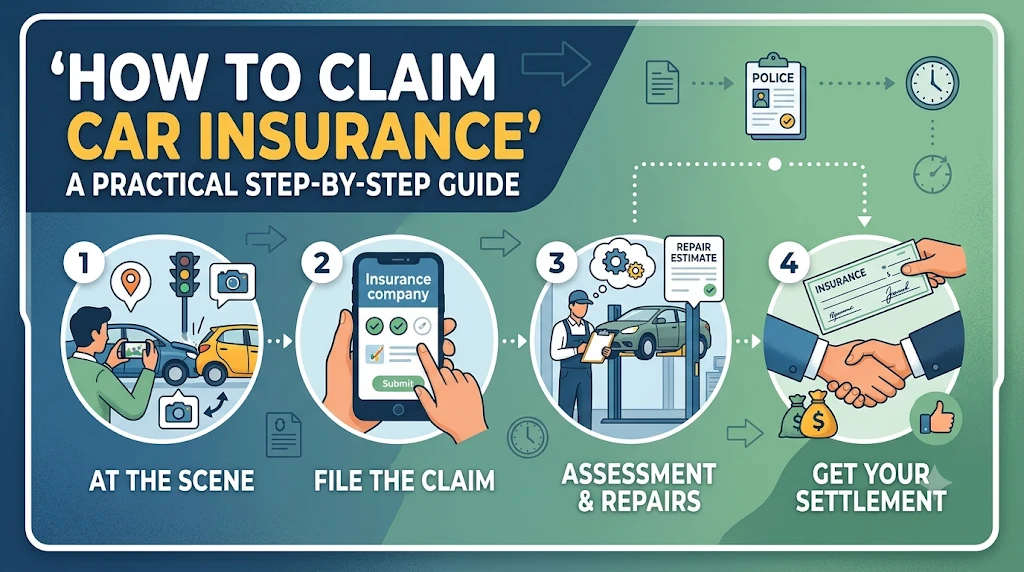
What you do — or don’t do — in the first 15 minutes matters a lot to your claim later. Here’s what to handle at the scene:
Check for injuries first. Yourself, your passengers, the other driver. If anyone’s hurt, call emergency services immediately. Nothing else matters until that’s sorted.
Move to safety if possible. If the cars are drivable, move them off the road. If not, turn on hazards and stay visible.
Call the police. Even for minor accidents, having a police report is incredibly valuable when filing a claim. Some insurance companies won’t process claims without one, and it becomes your official, unbiased record of what happened. Don’t skip this step.
Document everything. This is the big one. Get your phone out and photograph:
- Both vehicles (wide shots and close-ups of damage)
- License plates of all vehicles involved
- The overall scene — road markings, traffic lights, any relevant signage
- Any skid marks or debris
- The other driver’s insurance card, license, and registration
Exchange information — full name, phone number, insurance company name, policy number, and vehicle registration. Don’t just take their word for it; photograph the documents directly.
Talk to witnesses. If anyone stopped, ask if they’d be willing to give a statement to police and get their contact info. Eyewitness accounts can make or break a disputed claim.
One thing I did wrong the first time: I was so relieved nobody was hurt that I kind of rushed through this part. I got the other driver’s phone number but forgot to photograph their insurance card. It caused a delay of almost a week because the insurance companies had to verify coverage manually. Don’t repeat my mistake.
Understanding What Kind of Claim You’re Filing
Before you call your insurance company, it helps to know which type of claim situation you’re in. There are basically three scenarios:
You were at fault. Your liability coverage kicks in to cover the other party’s damages. Your own collision coverage (if you have it) covers your vehicle.
The other driver was at fault. You can file a third-party claim with their insurance company. Or you can file with your own insurer and let them go after the other party — this is called subrogation.
Unknown fault / hit-and-run / single vehicle. Your own collision or uninsured motorist coverage handles this.
In my first accident, the other driver was clearly at fault. I initially filed directly with his insurer (third-party claim) because I thought it would be simpler. It wasn’t. Their adjusters were slow to respond, and since I wasn’t their customer, I wasn’t exactly a priority. Eventually I had to rope in my own insurer to push things along.
Lesson learned: If the other driver’s insurance is dragging their feet, don’t hesitate to go through your own insurer. Yes, you might pay your deductible upfront, but your insurer has a financial incentive to get your money back — and they’ll often handle the process much more aggressively on your behalf.
Step-by-Step: How to Actually File the Claim
Step 1: Notify Your Insurance Company ASAP
Most policies require you to report an accident “promptly” or “within a reasonable time.” That usually means within 24–48 hours. Don’t wait.
Call the claims number on the back of your insurance card, or log into your insurer’s app. Most major insurers — State Farm, GEICO, Progressive, Allstate — have mobile apps now where you can start a claim, upload photos, and even schedule inspections without ever talking to a person if you prefer.
When you call or submit, you’ll need:
- Your policy number
- Date, time, and location of the accident
- A description of what happened
- The police report number (if you have it)
- Information about the other parties involved
Don’t speculate about fault during this call. Just describe the facts. Say “the other vehicle collided with the rear of my car at a red light” rather than “I think maybe I could’ve moved faster” or anything that could be interpreted as partial admission.
Step 2: The Claims Adjuster Gets Assigned
Within a day or two, you’ll be contacted by a claims adjuster — either from your insurer or the at-fault party’s. Their job is to investigate the accident and determine how much the company owes.
They’ll review the police report, look at the photos, may want to talk to witnesses, and will arrange for your vehicle to be inspected.
Be cooperative but careful. You’re not required to give a recorded statement to the other driver’s insurance company. Your own insurer’s policy may require it, but for third-party claims, you can decline recording or have things go through written communication. A lot of people don’t know this.
Step 3: Vehicle Inspection and Repair Estimate
Your car will need to be assessed. There are two main ways this happens:
You take it to an insurer-approved shop. These are repair shops that have a direct relationship with the insurer. Estimates are handled digitally and often the insurer pays the shop directly — you just pay your deductible.
You get your own estimate. You can take your car to an independent shop you trust and submit that estimate to the insurer. They may negotiate the price, but you have the right to use a shop you choose.
My preference is to use a shop I’ve been to before and trust, then submit that estimate. The direct-pay convenience of approved shops is nice, but I’ve had better experiences with quality control when I chose my own mechanic.
If your car is undriveable, ask about a rental car reimbursement — most comprehensive policies cover this. Don’t assume it’s automatic; specifically request it when you file.
Step 4: Review the Settlement Offer
Once the damage is assessed, you’ll receive a settlement offer. This covers repair costs, and if applicable, any medical expenses, rental car costs, or diminished value.
Read it carefully. Insurance companies aren’t inherently evil, but they’re also not going to volunteer money you don’t ask for. Common things people miss:
- Diminished value: Even after your car is perfectly repaired, it’s worth less because it has an accident on its record. You can claim this in most states. Most people never do.
- OEM vs. aftermarket parts: Check whether the estimate uses original manufacturer parts. You have the right to request OEM parts in many cases.
- Pre-existing vs. new damage: If an adjuster tries to exclude something as “pre-existing,” ask for documentation showing how they determined that.
You can negotiate. This is something that surprised me — the first offer isn’t always final. If you have your own independent estimate that’s higher, present it. If comparable vehicles in your area are listed higher than their total loss valuation, show them. Bring evidence, stay calm, and push back.
Step 5: Accept the Settlement and Get Paid
Once you agree on a number, you’ll sign a release form and receive payment. If it’s a repair job, the money typically goes to the shop. If it’s a total loss (repair cost exceeds a certain percentage of the car’s value), you’ll receive a cash payout for the vehicle’s actual cash value.
For total losses, you’ll need to sign over the title to the insurance company.
Handling a Hit-and-Run
My second insurance experience was a parking lot hit-and-run. Someone clipped the side of my car hard enough to crack the door panel and disappeared. No note. No witnesses I could find.
Here’s what to do in this situation:
- File a police report immediately, even if you don’t have the other driver’s info. The report documents the incident.
- Check for security cameras. Parking lots at grocery stores, malls, gas stations — many have cameras. Ask the property manager if footage exists before it’s overwritten (usually within 24–72 hours).
- File with your own insurer under your uninsured motorist property damage (UMPD) or collision coverage.
- Expect to pay your collision deductible since there’s no at-fault party to recover from (unless the other driver is found).
The process is the same as above from Step 2 onward. The only real difference is there’s no third party involved, so everything goes through your own insurer.
Common Mistakes That Delay or Reduce Your Claim
After going through this process twice and talking to enough people who’ve been through it more, here are the slip-ups I see most often:
Waiting too long to report. Some people think reporting an accident will automatically raise their rates, so they delay. But waiting too long can actually give the insurer grounds to deny or reduce your claim. Report it promptly, and ask your agent how it might affect your premium before assuming the worst.
Posting on social media. Seriously — don’t post anything about the accident on Instagram, Facebook, or anywhere public while the claim is open. Adjusters and attorneys for the other side do look at this.
Accepting a quick verbal settlement at the scene. Sometimes the other driver offers to “just pay you cash” to avoid involving insurance. This might seem convenient, but if the damage turns out to be more than expected, or if you have injuries that appear days later (soft tissue injuries are like this), you have no recourse. Get it on record.
Not documenting injuries. If you feel even slightly off after the accident — stiff neck, headache, back pain — see a doctor that day or the next. Injuries that aren’t documented immediately are much harder to include in a claim later.
Throwing away receipts. If you paid out of pocket for anything related to the accident — a rental car, a taxi, medication — keep every receipt. These are reimbursable.
Apps and Tools That Actually Help
A few things that made the process easier for me:
Your insurer’s mobile app. GEICO, State Farm, and most major carriers have solid apps now. You can file claims, upload photos, and track status without spending 45 minutes on hold. Use them.
Google Maps or Apple Maps timeline. If you use location history, your phone can actually show your route at the time of the accident — useful if the location gets disputed.
CCC One (used by insurers) vs. your own research. If you’re disputing a total loss valuation, use sites like Autotrader, CarGurus, and Kelley Blue Book to pull comparable listings in your area. Present them to the adjuster as evidence of market value.
Claim your state insurance department’s website. Every state has one. If you feel like your insurer is acting in bad faith — unreasonable delays, unjustified denials — you can file a complaint. Insurers take these seriously.
When to Consider Getting a Lawyer
Most straightforward property damage claims don’t require legal help. But you should consider consulting a personal injury attorney if:
- You or a passenger suffered significant injuries
- The other driver was uninsured and your damages exceed your UMPD limits
- The insurer denies your claim outright and you believe it’s unjustified
- There’s a genuine dispute about who was at fault
Many personal injury attorneys work on contingency (they only get paid if you win), so at minimum, a free consultation can clarify your position without costing you anything.
A Few Things Nobody Tells You
Your rates may not go up as much as you think. Especially if you weren’t at fault. Many states prevent insurers from raising rates on not-at-fault accidents, and even where they can, the increase is often smaller than people fear.
You can reopen a claim in some cases. If you settled too quickly and discover additional damage later, there’s sometimes a window to reopen. Don’t assume it’s closed forever.
Diminished value is real money. I mentioned this above but it’s worth repeating — if your car was in an accident and is now repaired, its trade-in or resale value is lower. You can claim this. Most people don’t, and insurers aren’t going to remind you.
Medical payments coverage vs. health insurance. If your auto policy includes MedPay or PIP (Personal Injury Protection), that can cover medical bills regardless of fault, often without a deductible. Check your policy — you might have this and not realize it.
Wrapping This Up
Car insurance claims aren’t fun. Nobody wants to deal with them. But they’re also not as complicated as they might seem in the moment, especially once you’ve been through it once.
The core of it is simple: document everything at the scene, report quickly, know your coverage, and don’t be afraid to push back if an offer doesn’t seem right.
The biggest shift for me between my first claim and my second was confidence. The first time I just accepted whatever the adjuster said because I didn’t know I could question it. The second time I came prepared, asked better questions, and ended up with a better settlement.
You’ve got more leverage than you think. Use it.
Have questions about a specific situation? Drop them in the comments below — I try to answer based on what I’ve actually been through.



