
I still remember the day my uncle sat across from me at the dinner table, shaking his head after filing a car insurance claim. His fender bender was minor — a parking lot scrape, maybe $900 in damage — but the process took two weeks, three phone calls, and a whole lot of frustration. He finally got his check, but then his premium went up the next year.
“These companies win no matter what,” he muttered.
He wasn’t wrong. But I didn’t fully understand how right he was until I started digging into the actual business model of insurance — partly out of curiosity, partly because I was looking at buying life insurance and wanted to know exactly who I was handing money to every month.
What I found was honestly fascinating. And a little unsettling. These companies aren’t just gambling that you won’t get sick or crash your car. They’ve built one of the most mathematically precise money-making machines in history. Let me break it all down for you.
The Basic Premise Most People Get Wrong
Most people think insurance companies make money by “hoping you never file a claim.” That’s… not really accurate.
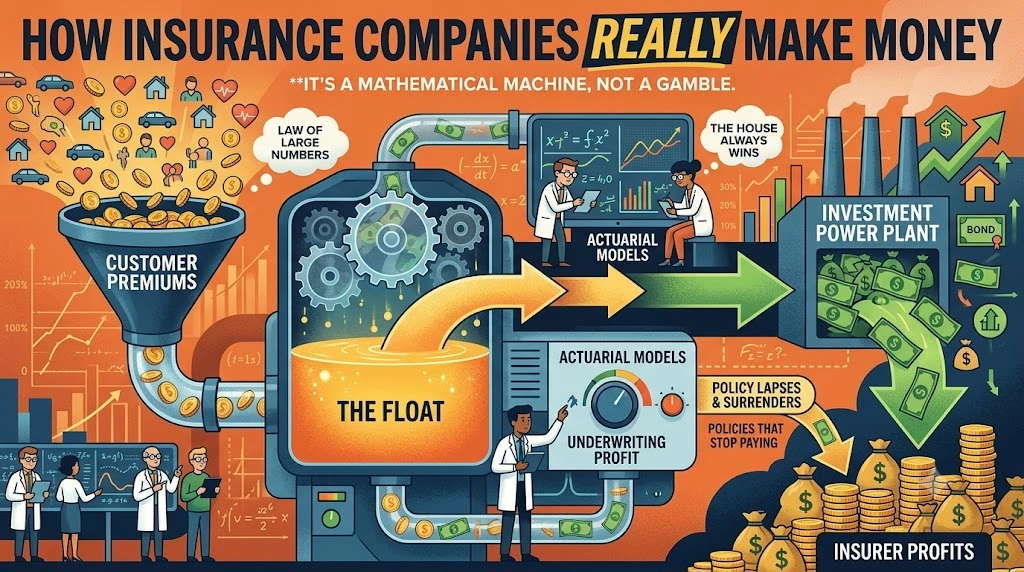
Yes, they benefit when you don’t claim. But the business is way more sophisticated than a simple bet. Insurance is actually built on something called the law of large numbers — the idea that the more customers you have, the more predictably you can model risk.
Think of it like a casino. Individual bets are unpredictable, but across thousands of bets, the house always wins because the math is baked in. Insurance works the same way, except instead of roulette wheels, they’re using actuaries with spreadsheets.
Revenue Stream #1: Premiums (The Obvious One)
Every month, you pay a premium. Your neighbor pays one. Millions of other people pay one. That money pours into the insurer’s accounts continuously.
Here’s the key thing most people miss: not all of that money goes to pay claims.
Let’s say a health insurance company collects $1,000 per month from you. They might pay out $700 on average in claims. That leaves $300 — before they even invest a single rupee or dollar.
This gap between premiums collected and claims paid is called the underwriting profit (or underwriting loss, if the company messes up its math). Good insurers consistently keep this positive. Bad ones go bankrupt.
The way they keep it positive? Underwriting — the actual process of deciding who to insure and at what price.
When you applied for car insurance and they asked about your driving history, your age, where you park at night, and whether you’ve had accidents — that wasn’t small talk. That was them running your profile through risk models to make sure they charge you more than they’ll likely pay out for you.
I had a friend who had two minor accidents in three years. His premium was nearly double mine. The company didn’t hate him. They just priced him correctly (from their perspective).
Revenue Stream #2: Investment Income (The Sneaky Big One)
This is where it gets genuinely interesting — and this is the part nobody explains to you when you’re signing up for a policy.
When you pay your premium in January, the insurer doesn’t immediately need that money to pay claims. Most claims happen gradually over the year. So what do they do with your money in the meantime?
They invest it.
The pool of money held by an insurance company to pay future claims is called the float. And the float is enormous. We’re talking billions of dollars sitting in bonds, equities, real estate, and other financial instruments — all earning returns while the company waits to pay claims.
Warren Buffett has written about this for decades. Berkshire Hathaway owns GEICO, and Buffett has been very open that insurance float is one of the greatest financial structures ever invented. You’re essentially getting paid to hold other people’s money — except in insurance, you’re the one giving up the money.
Here’s a simplified example: Say an insurer collects $500 million in premiums in a year. They might not pay out most claims until months later. During that window, even a conservative 4–5% return on that float generates tens of millions in investment income — sometimes enough to offset an entire underwriting loss and still turn a profit.
This is why large insurers like Berkshire, AIG, or major domestic insurers in any country can sometimes afford to price policies aggressively — because even if they barely break even on underwriting, the investment income more than compensates.
Revenue Stream #3: Policy Lapses and Surrenders
This one hits differently once you understand it.
Life insurance companies sell policies. Some people stop paying premiums — they lapse. With many term life policies, if you lapse, you lose everything you’ve paid and the insurer keeps it with zero obligation.
With certain whole life or endowment policies, there’s a surrender value — but it’s usually much less than what you’ve paid in, especially in the early years. The insurer keeps the difference.
This isn’t fraud. It’s fully disclosed in the fine print. But a lot of people don’t realize how much lapse income contributes to insurer profits, especially in markets where financial literacy is lower and people sign up for policies they can’t sustain long-term.
I remember reviewing a life insurance quote where the agent was pushing hard for a 20-year endowment plan. When I asked about the surrender charges in year 3, there was an awkward pause. The early surrender penalties were steep — by design.
Revenue Stream #4: Reinsurance Arbitrage
This one’s a bit advanced but worth knowing.
Big insurance companies don’t carry all the risk themselves. They buy insurance for themselves — called reinsurance — from massive firms like Munich Re, Swiss Re, or Gen Re.
Here’s where it gets interesting: if a primary insurer prices its policies well and the reinsurance it buys is cheaper than the risk it’s offloading, it’s essentially profiting on the spread. It’s like being a middleman who buys wholesale and sells retail, except the “products” are financial risks.
Smaller insurers lean on reinsurance heavily to survive catastrophic events (think floods, earthquakes, pandemics). Larger ones use it strategically to optimize capital efficiency.
Revenue Stream #5: Fees, Add-ons, and Riders
Walk into any insurance agent’s office and you’ll walk out with a brochure for riders — add-ons to your base policy.
Critical illness rider. Accidental death benefit. Waiver of premium. Return of premium. Each adds a small amount to your monthly cost. Together, they significantly boost the insurer’s revenue per customer.
Some of these riders are genuinely useful. Others are… less so. The key is that insurers often price riders with healthy margins because customers find it hard to comparison-shop something so specific. You’re not comparing 10 “waiver of premium riders” across providers — you’re just saying yes or no to one in a stressful meeting with an agent.
How Actuaries Make All This Possible
Let me give credit where it’s due — the math behind insurance is genuinely impressive.
Actuaries are the people who crunch the numbers to figure out exactly how much risk a company is taking on and what to charge for it. They use mortality tables, accident frequency data, weather modeling, economic projections, and increasingly, machine learning to price risk incredibly precisely.
They know, statistically, how many 35-year-old non-smoking males in a given city will develop heart disease in the next decade. They know how many cars in a given zip code will be stolen. They know how many homes in a coastal region will flood.
When you’re priced as an individual, you’re being compared to thousands of people who look like you statistically. If you’re lower risk than average, you might be subsidizing higher-risk customers slightly — but the insurer’s overall book is balanced.
The scary part? They’re often better at predicting your future health than your own doctor.
What Can Go Wrong (When It Does)
Insurance companies aren’t invincible. They can — and sometimes do — fail.
The most common ways:
Underpricing risk. If an insurer tries to grab market share by offering premiums that are too low, they can end up paying out far more than they collected. This has happened with health insurers entering new markets without good data.
Catastrophic events. A single massive earthquake, pandemic, or hurricane can wipe out reserves and reinsurance limits simultaneously. COVID-19 caused significant losses for some life and health insurers globally.
Investment losses. If the float is invested poorly — or if markets crash at the wrong time — the investment income that props up the business can evaporate.
Regulators in most countries require insurers to maintain solvency margins — minimum capital reserves — precisely to prevent collapses. But it still happens.
The Customer Side: What This Means for You
Understanding how insurers make money doesn’t mean you should ditch your policies. Insurance is genuinely useful. The point is to use that knowledge to your advantage.
1. Pay annually if you can. When you pay monthly, the insurer bills you a service fee or builds it into a slightly higher effective rate. Annual payments typically save you 5–10%.
2. Don’t over-insure. If you have significant savings, a higher deductible means a lower premium. You’re essentially self-insuring the small stuff and offloading only catastrophic risk to the company — which is what insurance is actually for.
3. Watch your riders carefully. Ask your agent to break down exactly how much each rider costs and what specific scenario it covers. Some are worthwhile; others are margin-boosters for the insurer.
4. Review policies annually. Life changes — marriage, kids, property, income. Your insurance needs to change with it. Staying in an outdated policy often means you’re either over-covered (paying for things you don’t need) or under-covered (in for a nasty surprise when you claim).
5. Understand lapse consequences. Before signing a long-term policy, ask explicitly: “What happens if I stop paying after Year 2? Year 3? Year 5?” Know the surrender schedule before you commit.
Common Mistakes People Make
I’ve watched friends and family make these:
Buying on price alone. The cheapest policy can be cheap because the insurer has terrible claim settlement ratios. Always check an insurer’s claim settlement data — in many countries, this is publicly available. In India, for example, IRDAI publishes claim settlement ratios for life insurers every year. Use it.
Assuming the agent is on your side. Most agents are commission-driven. That doesn’t make them dishonest — many are genuinely helpful — but their incentives don’t always align with yours perfectly. A policy that earns them higher commission might get pushed a little harder.
Ignoring the exclusions. The exclusions section of an insurance policy is where the “real” policy lives. What isn’t covered is as important as what is. I’ve known people who bought health insurance thinking it covered pre-existing conditions, only to find a 3-year waiting period buried in clause 4.2.
Letting it auto-renew without review. Every auto-renew without review is an opportunity to overpay, remain underinsured, or carry a policy that no longer fits your life.
A Quick Reality Check on the “Evil Insurer” Narrative
Here’s something I’ll be honest about: insurance companies get a lot of hate, some of it deserved and some of it not.
Yes, they profit from risk. Yes, they fight some claims. Yes, the whole system is designed to collect more than it pays out. But they also provide something genuinely valuable — the ability to transfer catastrophic risk off your personal balance sheet.
Without insurance, a single car accident, illness, or house fire could wipe out years of savings. The price you pay for not having to carry that risk personally is the premium. Whether that price is fair depends heavily on which insurer you pick, what you read before signing, and how you use the product.
The people who come out ahead with insurance are the ones who understand exactly what they’re buying and why.
So… Are They Just Taking Your Money?
Sort of. But so does every business.
The grocery store buys rice for less than they sell it to you. The bank uses your deposits to make loans at higher interest rates. Insurance companies collect premiums, invest the float, and pay out less (on average, across their portfolio) than they collect.
What makes insurance different — and what my uncle couldn’t fully articulate at that dinner table — is the scale and sophistication of the operation. Every data point you’ve ever given them is fed into models that are continuously refined. They know risk better than almost anyone.
Your job, as the customer, is to understand their model well enough to buy intelligently. Not to beat them at their own game — that’s nearly impossible — but to make sure what you’re paying for is actually protecting what matters to you.
That’s the real power move.
Want to go deeper? If you’re evaluating a specific type of insurance — health, life, motor, or property — the math and fine print varies significantly. Drop a comment or question below and I’ll dig into whichever one is on your mind.

**Moon Awan** is the founder of MotoPolicy and a research-driven content creator focused on insurance and financial protection topics. With a strong background in building structured digital platforms, he specializes in analyzing and presenting complex insurance information in a clear and practical way.
At MotoPolicy, his work focuses on areas such as car insurance, health insurance, and policy comparison strategies. He continuously studies insurance trends, coverage structures, and pricing models to provide accurate and up-to-date insights that help readers make informed decisions.
His approach combines technical precision with in-depth research, ensuring that every article is well-organized, easy to understand, and useful for real-world applications.
Through MotoPolicy, his goal is to build a trusted resource where users can confidently learn about insurance, compare options, and improve their financial awareness.
While all content is carefully researched, readers are encouraged to consult licensed professionals for personalized insurance advice.


