
Last year, I was staring at my car insurance bill and doing the math I’d been avoiding for months.
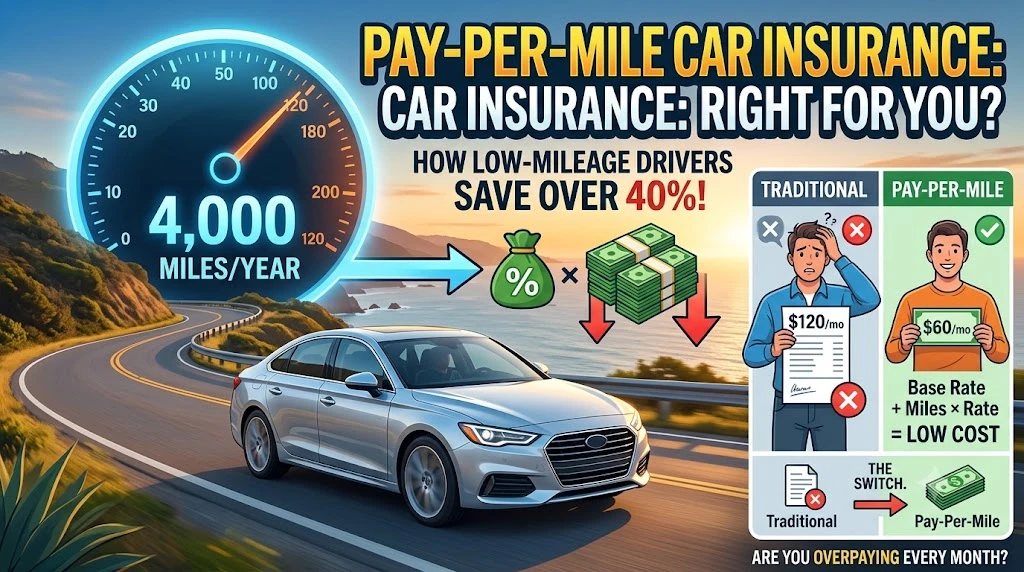
I drive maybe 4,000 miles a year. My neighbor, who commutes 45 minutes each way to work five days a week, probably puts on 20,000+. We were paying nearly the same monthly premium.
That felt wrong. And it was wrong.
A coworker mentioned pay-per-mile insurance in passing during lunch, and I brushed it off as some gimmick. “Isn’t that just telematics?” I asked. She shook her head. So that evening I actually sat down and dug into it — and what I found genuinely surprised me. Six months later, I’d cut my car insurance cost by over 40%.
Here’s everything I wish someone had explained to me before I spent years overpaying.
So What Actually Is Pay-Per-Mile Car Insurance?
Let me skip the dictionary definition and just explain it the way I finally understood it.
Traditional car insurance charges you a flat monthly or annual rate. Whether you drive 500 miles that month or 5,000, you pay the same. The insurer is essentially betting on your average risk — and they build in a healthy cushion to make sure they come out ahead.
Pay-per-mile flips that model. You pay a small base rate every month (which covers you even when the car is parked), and then an additional per-mile rate for every mile you actually drive. The more you drive, the more you pay — and the less you drive, the more you save.
The formula is basically this:
Monthly Cost = Base Rate + (Miles Driven × Per-Mile Rate)
So if your base rate is $30/month and your per-mile rate is $0.06, and you drive 400 miles that month — you’d pay $30 + $24 = $54. Simple.
Compare that to what you might pay for traditional insurance on a similar coverage level — often $90 to $150+ per month — and you can see why low-mileage drivers start paying attention.
Who Is This Actually Good For? (And Who Should Skip It)
I want to be honest here because I’ve seen some articles oversell this like it’s right for everyone. It’s not.
You’ll likely benefit if you:
- Work from home or have a short commute
- Live in a city where you walk, bike, or use transit a lot
- Have a second car that barely gets used
- Are retired or semi-retired
- Drive seasonally (think: convertible in summer only)
- Are a college student with a car that mostly sits in a parking lot
It might not be the right fit if you:
- Commute long distances every day
- Frequently take road trips
- Log more than 12,000–15,000 miles per year
- Drive for gig work like Uber, Lyft, or DoorDash (you’d need commercial coverage anyway)
I know someone who did the switch, got excited, and then realized he’d underestimated how much he actually drives. His bill ended up higher than his old plan. He wasn’t thrilled. The lesson: pull up your odometer readings from the last couple of years before you decide anything.
How the Mileage Tracking Actually Works
This is the part that weirded me out at first, and I know I’m not alone.
Most pay-per-mile insurers track your mileage using a small plug-in device — sometimes called a telematic tag or mileage tracker — that goes into your car’s OBD-II port. That’s the diagnostic port usually located under the dashboard on the driver’s side. It’s the same port mechanics use when they plug in to read error codes.
The device simply counts your miles and reports them back to the insurance company. The major players in this space — Metromile (now owned by Lemonade), Allstate Milewise, Nationwide SmartMiles, and Mile Auto — each handle this slightly differently.
- Metromile/Lemonade uses a plug-in device called the Pulse that also connects to an app. Beyond mileage, it can help you find your parked car, detect trips, and even diagnose car problems.
- Allstate Milewise uses a plug-in tag too, but the experience is more traditional insurance-company-style — less startup-y.
- Mile Auto takes a different approach entirely: they just ask you to submit a photo of your odometer every month. No device needed. Honestly kind of refreshing.
- Nationwide SmartMiles is another solid option with a plug-in device and a cap on daily miles so you’re not penalized on long road trip days.
One thing I really appreciated about Metromile’s app was the breakdown of each trip. You could literally see every drive you took and the cost associated with it. That kind of transparency changed how I thought about unnecessary errands — in a good way.
The Privacy Question (Because You’re Going to Think About It)
Look, I thought about it too.
You’re essentially letting an insurance company track where you drive and when. That’s a real tradeoff, and I don’t want to gloss over it.
Most of these companies say they only use the data for billing purposes and don’t sell your location history to third parties. But you should read the privacy policy of whichever company you’re considering — actually read it, not just click “I agree.”
Mile Auto’s model is the most privacy-friendly since it’s just an odometer photo, no GPS, no real-time tracking. If that matters a lot to you, it might be worth the slightly clunkier monthly check-in process.
Some people are genuinely uncomfortable with any tracking, and I respect that. There’s no right answer — just your answer.
Step-by-Step: How to Switch to Pay-Per-Mile Insurance
If you’re ready to at least look into it, here’s how I’d walk through it:
Step 1: Calculate your actual annual mileage.
Don’t guess. Pull up your old inspection records, check your odometer, or look at past oil change receipts (most shops record the mileage). Figure out roughly how many miles you put on in a year and divide by 12 to get a monthly average.
Step 2: Get your current insurance cost.
Write down your current monthly premium and what coverage you have (liability limits, comprehensive, collision, deductible amounts). You’ll want to compare apples to apples later.
Step 3: Get quotes from pay-per-mile providers.
Start with Metromile (now through Lemonade), Allstate Milewise, and Nationwide SmartMiles. If you’re in a state where Mile Auto operates, check them too. Most have online quoting tools that take about 5–10 minutes.
When you get a quote, ask specifically: What’s my base rate? What’s my per-mile rate? Is there a daily mileage cap?
Step 4: Do the math for your situation.
Take your monthly average miles and plug it into the formula: Base Rate + (Miles × Per-Mile Rate). Then compare to your current premium for equivalent coverage. If the savings are meaningful, keep going. If not, at least you know.
Step 5: Read the fine print.
Specifically look for: cancellation policies, how they handle disputed mileage readings, what happens if the device malfunctions, and whether they track any behavior data beyond mileage (like hard braking or speed).
Step 6: Make the switch when your current policy is up for renewal.
Avoid mid-term cancellation fees. Time it right and you won’t lose any prepaid premium.
My Actual Experience After 6 Months
When I switched, I was paying around $118/month for a decent coverage plan on my 2019 Honda CR-V. I’m in my mid-30s, clean driving record, no accidents. By any measure, I should have been getting a better rate — but the traditional model doesn’t really reward you for barely using the car.
After switching to pay-per-mile, my first month came in at $54. Second month was around $61 because I took a few extra weekend drives. Highest month was $79 when I visited some friends out of town.
Over six months, I paid an average of $63/month. That’s roughly $55/month in savings — or about $660 a year. Not life-changing, but not nothing either.
The app I used showed me each trip, which was oddly satisfying. And knowing that a spontaneous drive to the grocery store actually has a price (even a tiny one) made me combine errands more naturally. I wasn’t obsessing over it, but the awareness was there.
One small annoyance: the OBD-II device occasionally disconnected when I had the car detailed and someone messed with the port area. Customer support sorted it out pretty quickly, but it was mildly irritating.
Common Mistakes People Make When Switching
1. Not accounting for seasonal changes. If you drive a lot more in summer (road trips, camping, visiting family), your summer bills will spike. Budget for that in advance instead of being surprised.
2. Forgetting about the base rate. Some people see a low per-mile rate and assume their bill will be tiny. But if the base rate is high, the math might not work in your favor for lower-mileage months. Always calculate the total.
3. Choosing coverage that’s worse just to save money. Some people switch insurers and quietly lower their liability limits without realizing it. Keep your coverage levels the same when comparing, or you’re not actually comparing the same thing.
4. Assuming it works for business use. If you drive for Uber, Lyft, delivery apps, or use your car for any business purpose, personal pay-per-mile insurance probably won’t cover you during those rides. You’d need rideshare endorsements or commercial coverage.
5. Not checking if the provider operates in your state. Availability varies. Metromile, for instance, doesn’t operate in every state. Always verify before getting attached to a specific provider.
A Few Real Scenarios Where This Makes a Lot of Sense
The remote worker with a car: My friend moved to full-time remote work during the pandemic and never really went back to the office. Her car now sits in the garage most of the week. She switched to pay-per-mile and estimated she’s saving nearly $800/year. She calls it “one of the easiest wins” she’s found.
The two-car household: If you have two cars but one barely gets driven (the “nice weather” car, the backup vehicle, etc.), putting that second car on pay-per-mile can make a lot of financial sense while keeping it properly insured.
The new driver living at college: Kids at school often have a car on campus that barely moves. Parents paying standard insurance on that car are probably overpaying significantly. Pay-per-mile is a natural fit here.
The urban dweller who keeps a car for “just in case”: Some people in cities keep a car they drive maybe once or twice a week. They’re typically getting crushed by flat-rate premiums. A pay-per-mile model could cut their insurance bill dramatically.
What Traditional Insurers Don’t Want You to Know
I say this a little tongue-in-cheek, but there’s truth in it.
The standard car insurance model has always grouped you with other drivers who look like you statistically — age, zip code, credit score, car type — and priced your risk accordingly. Your actual driving behavior? Mostly irrelevant under that model.
Pay-per-mile starts from a fundamentally different premise: the biggest predictor of getting into an accident is how much time you spend on the road. More miles = more exposure = more risk. It sounds obvious, but the industry didn’t price it that way for a long time because tracking miles at scale wasn’t easy.
Now that the technology is trivial, it’s hard to justify the old model for low-mileage drivers. And increasingly, they’re voting with their feet.
Is There a Catch?
Honestly? Not a big one, if you know what you’re getting into.
The tracking aspect is a real thing you have to be comfortable with. Some people aren’t, and that’s valid.
The math only works in your favor below a certain mileage threshold. If you’re edging toward 12,000–15,000 miles per year, you should run the numbers carefully rather than assume you’ll save.
And the providers available to you depend on where you live. The market is still growing, so options in some states are limited.
But if you’re a low-mileage driver who’s been on autopilot with the same insurance company for years? You owe it to yourself to at least run the numbers. The worst case is you find out your current plan is actually competitive. The best case is you find out you’ve been leaving several hundred dollars on the table every year.
Where to Start Right Now
If this has your attention, here’s a quick action list:
- Check your mileage: Look at your last oil change receipt or your state inspection paperwork for last year’s odometer reading.
- Get a quote from Metromile/Lemonade or Allstate Milewise — both have fast online tools.
- Compare coverage levels carefully, not just prices.
- Make a decision at your next renewal date to avoid cancellation fees.
It took me maybe 45 minutes of research to figure out I could save $660 a year. That’s a pretty good hourly rate for homework.
If your car spends more time in the driveway than on the road, the traditional insurance model simply isn’t built for you. Pay-per-mile exists exactly for people like us — and it’s worth taking seriously.

**Moon Awan** is the founder of MotoPolicy and a research-driven content creator focused on insurance and financial protection topics. With a strong background in building structured digital platforms, he specializes in analyzing and presenting complex insurance information in a clear and practical way.
At MotoPolicy, his work focuses on areas such as car insurance, health insurance, and policy comparison strategies. He continuously studies insurance trends, coverage structures, and pricing models to provide accurate and up-to-date insights that help readers make informed decisions.
His approach combines technical precision with in-depth research, ensuring that every article is well-organized, easy to understand, and useful for real-world applications.
Through MotoPolicy, his goal is to build a trusted resource where users can confidently learn about insurance, compare options, and improve their financial awareness.
While all content is carefully researched, readers are encouraged to consult licensed professionals for personalized insurance advice.


