
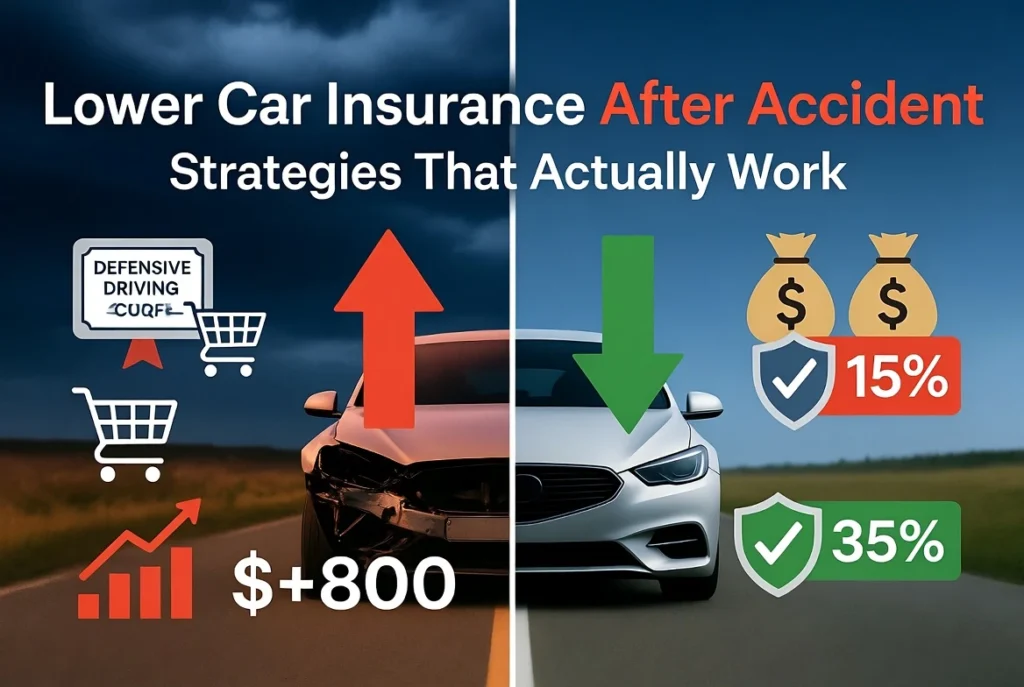
Your car insurance renewal just arrived in your inbox. You open it, scan the numbers, and feel your stomach drop. That at-fault accident from eight months ago? It just added $800 to your annual premium. Maybe more.
Therefore, you’re not alone. Drivers who cause an accident typically see rate increases between 30% and 50%, depending on their insurer, location, and driving history. For someone paying $1,500 annually, that’s an extra $450 to $750 per year—sometimes for three to five years.
But here’s what most people don’t know: that increase isn’t set in stone. You have more control over your post-accident rates than insurance companies want you to believe.
This guide breaks down exactly how to lower your car insurance after an accident, including strategies that work immediately, tactics that take time but offer bigger savings, and the mistakes that will keep your rates elevated longer than necessary.
Understanding How Accidents Affect Your Insurance Rates
Therefore. Insurance companies use risk algorithms to price your policy. Every data point—your age, location, credit score, claims history—feeds into a formula that predicts how likely you are to file a future claim.
When you cause an accident, that formula updates. You’ve demonstrated behavior that resulted in a payout, which statistically means you’re more likely to cause another one. The rate increase reflects that updated risk assessment.
But the math isn’t as brutal as it seems at first glance.
Insurance companies don’t simply add a flat “accident surcharge” to your previous rate. They recalculate your entire risk profile with the new accident included. This means other factors—like your age, credit improvement, or even moving to a safer zip code—can partially offset the accident’s impact.
The timing matters too. Most insurers look at accidents within the past three to five years when calculating rates. A minor fender-bender from four years ago barely registers. A major at-fault collision from six months ago hits hard.
The type of accident matters significantly. A rear-end collision at a stoplight where you admitted fault will spike your rates more than a sideswipe in a parking lot where fault was disputed. The dollar amount of the claim matters too—a $2,000 bumper repair affects your rates less than a $45,000 injury claim.
Understanding these variables is the first step to lowering your rates, because it shows you where you have leverage.
The Myths Keeping Your Rates High
Myth: You have to wait three years for rates to drop back down.
False. While insurers typically look at three to five years of history, you don’t have to passively wait. Switching insurers, improving other risk factors, or qualifying for new discounts can reduce your rates within months—not years.
Myth: All accidents affect your rates equally.
False. A not-at-fault accident often has zero impact on your rates in no-fault states or with insurers who don’t penalize for claims you didn’t cause. Even at-fault accidents are weighted differently based on severity, claim amount, and whether injuries were involved.
Myth: Your current insurer will automatically give you the best rate after an accident.
False. In fact, the opposite is often true. Insurers know you’re less likely to shop around after an accident because you assume nobody else will want your business. They exploit this by pricing aggressively at renewal, counting on your inertia to keep you paying.
Myth: Taking a defensive driving course won’t help after an accident.
False in many states. Numerous states mandate insurance discounts for completing approved defensive driving courses, regardless of your claims history. The discount typically ranges from 5% to 15% and applies for three years.
Myth: You should hide accidents from new insurers when shopping for quotes.
Dangerously false. Insurance applications ask about accidents within a specific timeframe. Lying constitutes material misrepresentation, which gives the insurer grounds to deny future claims or cancel your policy. They’ll find out anyway through CLUE reports (Comprehensive Loss Underwriting Exchange), which track your claims history across insurers.
Real Numbers: What an Accident Actually Costs You
Let’s look at concrete figures so you understand the financial impact and what “lowering” your rates actually means.
Scenario A: Minor At-Fault Accident (Under $2,000 Damage)
- Pre-accident annual premium: $1,400
- Post-accident annual premium: $1,820 (30% increase)
- Additional cost per year: $420
- Typical surcharge duration: 3 years
- Total extra cost over surcharge period: $1,260
B: Moderate At-Fault Accident ($5,000–$15,000 Damage)
- Pre-accident annual premium: $1,600
- Post-accident annual premium: $2,240 (40% increase)
- Additional cost per year: $640
- Typical surcharge duration: 3–5 years
- Total extra cost over surcharge period: $1,920–$3,200
C: Major At-Fault Accident (Injuries, $25,000+ Claim)
- Pre-accident annual premium: $1,800
- Post-accident annual premium: $2,700 (50% increase)
- Additional cost per year: $900
- Typical surcharge duration: 5 years
- Total extra cost over surcharge period: $4,500
These numbers vary by state, insurer, and individual driver profile. California, for instance, limits how long insurers can surcharge for accidents. New York allows longer surcharge periods but caps the percentage increase.
The key takeaway: even modest rate reductions after an accident translate to meaningful savings over time. A 10% reduction on Scenario B saves you $64 annually—$192 over the remaining surcharge period. A 20% reduction saves $384. These aren’t life-changing numbers, but they’re real money you don’t have to give away.
Pros and Cons of Aggressively Shopping After an Accident
Pros
- Immediate savings potential: Different insurers weight accidents differently. Company A might surcharge you 45%; Company B might only surcharge 25% for the same incident. Therefore shopping around often reveals significant pricing disparities.
- Resets the loyalty penalty: Insurers price aggressively at renewal for customers they think won’t leave. Switching disrupts this dynamic and often results in a lower baseline rate.
- Forces you to reassess coverage needs: The shopping process naturally leads to evaluating whether you’re over-insured or carrying unnecessary coverage that’s inflating your premium.
- Access to accident forgiveness programs: Some insurers offer accident forgiveness to new customers as a signup incentive, even if your current insurer doesn’t.
Cons
- Time investment: Getting accurate quotes requires providing detailed information to multiple insurers. Expect to spend 30–60 minutes per company if you want reliable numbers.
- Short-term complexity: Switching insurers means new policy documents, potential gaps in coverage if timing isn’t managed carefully, and adjusting automatic payments.
- Losing longevity benefits: Some insurers offer additional discounts for long-term customers (10+ years). Switching resets this clock, though the savings from a lower rate usually outweigh this benefit.
- Potential for worse customer service: The cheapest option isn’t always the best option. Lower premiums sometimes correlate with slower claims processing or more aggressive denial practices.
Real-Life Scenario: How Sarah Cut Her Post-Accident Rate by 28%
Sarah, a 34-year-old teacher in Ohio, rear-ended another vehicle at a stoplight in March. Her insurer, which she’d been with for six years, paid out $8,500 for the other driver’s vehicle repairs and minor injuries.
Therefore at her November renewal, her premium jumped from $1,320 annually to $1,782—a 35% increase.
Sarah assumed this was her new normal and nearly paid the renewal invoice without question. Instead, she spent a Saturday morning doing three things.
First, she called her current insurer and asked what specific discount programs she was missing. The representative discovered she qualified for a teacher association discount (8%) that had never been applied to her policy.
Second, she completed an online defensive driving course approved by Ohio for insurance discounts. The course took four hours and cost $35. It earned her a 10% discount on her premium.
Third, she obtained quotes from three other insurers. One quoted her $1,620. Another quoted $1,710. The third, a regional company she’d never heard of, quoted $1,340.
Her teacher discount and defensive driving discount reduced her current insurer’s renewal to $1,470. The regional company’s $1,340 quote was lower, but Sarah researched their claims satisfaction ratings and found concerning complaints about slow payouts.
She stayed with her current insurer at $1,470—a 17.5% reduction from the initial renewal offer and only 11% higher than her pre-accident rate.
Total time invested: six hours. Annual savings: $312. Cost of defensive driving course: $35. Net first-year savings: $277.
Comparison: Strategies to Lower Post-Accident Rates
| Strategy | Typical Savings | Time to Implement | Effort Level | Best For |
|---|---|---|---|---|
| Shop for new quotes | 15–35% | 2–4 hours | Medium | All drivers with at-fault accidents |
| Defensive driving course | 5–15% | 4–8 hours | Low | Drivers in states mandating discounts |
| Increase deductibles | 10–25% | 15 minutes | Low | Drivers with emergency savings |
| Bundle with home/renters | 10–20% | 30 minutes | Low | Homeowners or renters |
| Improve credit score | 5–20% | 1–6 months | High | Drivers with subprime credit |
| Add telemetry/safe driving app | 10–30% | 30 minutes + 90 days driving | Medium | Safe drivers willing to share data |
| Drop unnecessary coverage | 10–40% | 30 minutes | Low | Over-insured drivers |
| Ask for loyalty/discount review | 5–15% | 20 minutes | Low | Long-term customers |
| Wait for surcharge to expire | 20–50% | 3–5 years | None | Patient drivers |
Expert Strategies Most Drivers Never Try
Request a surcharge breakdown in writing.
Most drivers accept post-accident rate increases without understanding exactly how they’re calculated. Call your insurer and ask for a detailed breakdown showing your base rate, each individual surcharge, and every discount applied. Therefore this document reveals exactly where your money is going and which surcharges might be negotiable or removable.
Negotiate the accident classification.
Not all accidents are equal in an insurer’s eyes. If fault was disputed or shared, push for a “partial fault” or “not-at-fault” classification. Provide police reports, witness statements, or photos supporting your position. Even shifting from 100% at-fault to 50% at-fault can significantly reduce your surcharge.
Time your quote requests strategically.
Insurance algorithms consider how recently you’ve been shopping for quotes. Too many inquiries in a short period can actually increase your rates slightly. Space out your quote requests over 2–3 weeks, and avoid getting quotes immediately after your accident—wait at least 60 days so the initial shock has passed.
Leverage CLUE report errors.
Request your free CLUE report from LexisNexis. This report tracks your claims history and is what insurers use to verify your accident history. Errors on CLUE reports are surprisingly common—wrong dates, inflated claim amounts, or accidents listed that weren’t your fault. Disputing errors can improve your insurance profile immediately.
Consider a non-standard insurer temporarily.
Companies like Progressive, Geico, and State Farm serve preferred drivers. After an accident, you might get better rates from non-standard insurers like The General, SafeAuto, or Dairyland. These companies specialize in higher-risk drivers and often price accidents less aggressively. Use them for 12–18 months while the accident ages, then transition back to a standard insurer.
Explore named driver exclusion.
If another driver on your policy caused the accident, consider removing them from your policy entirely or excluding them via a named driver exclusion. This won’t help if you caused the accident, but it’s a powerful strategy for multi-driver households where one person’s record is dragging down everyone’s rates.
Increase your liability limits counterintuitively.
This sounds backwards, but higher liability limits can sometimes lower your overall premium because they move you into a different risk tier. Insurers have observed that drivers who carry higher limits tend to be more responsible. Request quotes at 50/100/50, 100/300/100, and 250/500/250—you might find the middle tier is actually cheaper than state minimum.
Who Should Pursue Aggressive Rate Reduction
Good candidates for shopping immediately:
- Drivers whose rates increased more than 30%
- Drivers with accidents over 12 months old (the surcharge softens over time)
- Drivers who haven’t compared rates in over two years
- Drivers whose credit scores have improved since their last quote
- Drivers who were previously with a preferred insurer but now fit non-standard profiles
Good candidates for waiting:
- Drivers with accidents less than six months old (surcharges are highest immediately, then gradually decrease)
- Drivers planning to move soon (location changes affect rates significantly)
- Drivers with additional accidents or violations pending (wait until your record stabilizes)
Poor candidates for switching:
- Drivers in the middle of an open claim (switching won’t help, and it complicates your current claim)
- Drivers with lapses in coverage (these hurt more than accident surcharges)
- Drivers who’ve already switched multiple times in the past year (insurers view this as instability)
Frequently Asked Questions
How long does an accident affect my insurance rates?
Most insurers surcharge for at-fault accidents for three to five years. The surcharge is highest in the first 12–18 months, then gradually decreases each renewal as the accident ages. Major accidents involving injuries may affect rates longer than minor property-damage-only accidents.
Will my rates increase if the accident wasn’t my fault?
In most states, no-fault accidents don’t increase your rates. However, some states allow insurers to consider not-at-fault accidents when setting rates. Check your state’s regulations and your specific policy language. If your rates increased after a not-at-fault accident, shop around—other insurers may not penalize you.
Can I remove an accident from my driving record?
You cannot remove accurate accident information from your motor vehicle record or CLUE report. However, you can dispute errors. If the accident details are incorrect—the date, fault determination, or claim amount—you can file disputes with the DMV and LexisNexis to have the record corrected.
Do all insurers charge the same amount for accidents?
No. Each insurer has its own surcharge schedule. The same accident might result in a 25% increase with one company and a 45% increase with another. This variation is why shopping around after an accident is so important—you’re not just looking for a lower base rate, you’re looking for an insurer that weights your accident less heavily.
Should I pay out of pocket to avoid filing a claim?
For minor accidents with damage under $1,000–$1,500, paying out of pocket often makes financial sense. Filing a claim triggers rate increases that cost more over three years than the immediate repair cost. However, this only works if you have the cash available and if the other driver agrees not to involve their insurance.
Will taking a defensive driving course actually lower my rates after an accident?
In states that mandate insurance discounts for defensive driving courses, yes. The discount applies regardless of your accident history. Check your state’s insurance department website for a list of approved courses. The discount typically ranges from 5% to 15% and remains in effect for three years.
What if I can’t afford my post-accident rates at all?
If your rates have become unaffordable, consider increasing your deductibles to the maximum allowed, dropping collision and comprehensive coverage if your vehicle is older than 10 years or worth less than $4,000, or switching to a non-standard insurer that specializes in high-risk drivers. As a last resort, explore your state’s assigned risk pool, which guarantees coverage but at higher rates.
Final Verdict: Take Action Within 90 Days of Your Renewal
An at-fault accident will increase your insurance rates. That’s unavoidable. What is avoidable is paying more than necessary for years because you accepted the first renewal offer without question.
The most effective approach combines immediate action with medium-term strategy. Within 90 days of your post-accident renewal, shop for competing quotes, complete a defensive driving course if your state offers a discount, and review your coverage for areas to trim. Simultaneously, start working on factors that improve your long-term rate trajectory—paying down debt to improve your credit score, maintaining a clean driving record, and avoiding additional claims.
Most drivers who follow this approach reduce their post-accident rate increase by 30% to 50% compared to doing nothing. For someone facing a $600 annual surcharge, that’s $180 to $300 per year back in your pocket—not life-changing, but meaningful enough to justify a few hours of effort.
Don’t let inertia cost you money. Insurance companies are counting on you to simply pay the renewal invoice. Prove them wrong.

**Moon Awan** is the founder of MotoPolicy and a research-driven content creator focused on insurance and financial protection topics. With a strong background in building structured digital platforms, he specializes in analyzing and presenting complex insurance information in a clear and practical way.
At MotoPolicy, his work focuses on areas such as car insurance, health insurance, and policy comparison strategies. He continuously studies insurance trends, coverage structures, and pricing models to provide accurate and up-to-date insights that help readers make informed decisions.
His approach combines technical precision with in-depth research, ensuring that every article is well-organized, easy to understand, and useful for real-world applications.
Through MotoPolicy, his goal is to build a trusted resource where users can confidently learn about insurance, compare options, and improve their financial awareness.
While all content is carefully researched, readers are encouraged to consult licensed professionals for personalized insurance advice.




what if i was in as accident in which the mistake wasn’t mine, then in that case will my premium price go up ?