
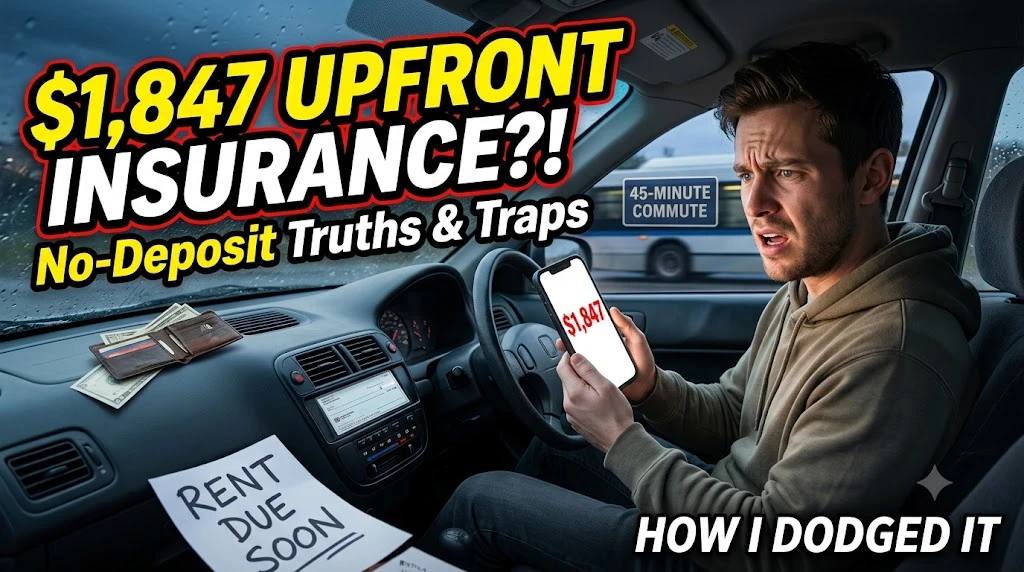
I’ll never forget the day I sat in my parked Honda Civic, staring at my phone screen in disbelief. The number staring back at me was $1,847. That was the upfront cost to insure a car I’d just paid $4,200 for. I had exactly $2,300 in my checking account, and rent was due in eleven days.
Let me back up a bit.
Six months earlier, I had been riding the bus to my tech support job, saving every penny I could. No car payment, no insurance premiums, no gas bills. It was miserable. The 45-minute commute each way ate into my sleep, my social life, and my sanity. When a coworker mentioned he was selling his old Civic, I jumped at the chance.
What I didn’t anticipate was the insurance wall.
See, I had made some questionable financial decisions in my early twenties. A couple of missed credit card payments, a medical bill that went to collections, and suddenly my credit score was sitting at a dismal 589. I knew my insurance rates would be higher, but I didn’t realize how much higher—or that I’d need to fork over nearly two grand just to start the policy.
That’s when I first heard about no-deposit car insurance.
A friend of mine who worked at a local insurance agency mentioned it casually over drinks. “Just get a no-deposit policy,” she said, like it was the most obvious solution in the world. “You pay month-to-month, no big upfront cost.”
Sounded perfect, right?
It wasn’t. At least, not entirely. Here’s what I learned the hard way, and what you need to know before you go down this road.
What No-Deposit Car Insurance Actually Is
Let me clear up a common misunderstanding right away. No-deposit car insurance doesn’t mean free insurance. It doesn’t even mean you pay nothing at signing. What it actually means is that instead of paying a large lump sum upfront—often one to two months of premium plus fees—you spread that initial cost out over your first few monthly payments.
Traditional insurance policies typically require you to pay your first month’s premium plus a down payment when you start coverage. That down payment might equal another month or two of premiums. If your monthly rate is $150, you might be looking at $300 to $450 just to get the policy active.
No-deposit options roll that initial cost into your ongoing payments. Instead of $450 upfront, you might pay $175 a month for the first three months, then it drops to the standard $150. You’re still paying the same total amount (actually, usually a bit more), but you don’t have to come up with that chunk of cash all at once.
The insurance companies aren’t being charitable here. They’re making a bet that you’ll stick around long enough for them to recoup that money, plus some extra for the convenience.
My Descent Into The No-Deposit Rabbit Hole
Armed with this new knowledge, I went home and started googling. Big mistake. Or rather, big warning sign that I ignored.
The first page of search results was flooded with websites promising “zero down payment car insurance” with headlines like “Get Insured Today For $0!” and “No Money Down Guaranteed!” The sites looked legit enough—professional designs, customer testimonials, phone numbers to call.
I spent two hours filling out quote forms on at least six different sites. Each one asked for the same information: my name, address, car details, driving history. Each one promised instant quotes. And each one eventually redirected me to a page that said something like “A licensed agent will contact you shortly with your personalized quote.”
Nobody contacted me with an actual quote. What I got instead was a barrage of phone calls over the next three days. Some were from legitimate insurance agents, but many were from lead generation companies that had sold my information to dozens of brokers. My phone was ringing off the hook with numbers I didn’t recognize.
One particularly aggressive guy called me four times in a single afternoon. When I finally answered and asked for a straight quote, he hemmed and hawed before admitting he couldn’t give me one without “running my full application” which required a credit check and more personal details than I was comfortable sharing with a stranger who had cold-called me.
Lesson learned: those “get a quote in seconds” sites are almost never what they claim to be. They’re lead generators, and once you submit your information, it’s out there being sold to the highest bidder.
Finding Legitimate Options
After that disaster, I changed my approach. Instead of clicking on flashy ads, I went directly to insurance companies I’d actually heard of.
I started with Progressive, mainly because I’d seen their commercials approximately ten thousand times and figured they must be doing something right. Their online quote process was straightforward—I could actually see estimated rates before giving them my phone number or email.
The standard quote they gave me required a $380 down payment. But buried in the payment options, there was a “pay monthly” selection that reduced the upfront cost to $47. That $47 wasn’t zero, but it was a hell of a lot better than $380.
The catch? My monthly payments jumped from $165 to $197 for the first three months. After that, they’d drop to the standard rate. Over the full six-month policy period, I’d pay about $90 more than if I had just forked over the down payment.
I tried the same approach with Geico. Their system was less transparent—I couldn’t see the no-deposit option until I’d created an account and gone through most of the application process. But once I did, I found a similar structure: lower upfront cost, higher monthly payments, slightly higher total cost over the policy term.
State Farm was a different experience entirely. When I called a local agent, she was upfront about the fact that State Farm generally requires down payments, though the amount varies by state and personal factors. She did mention that in some cases, they could work with me on the payment structure, but it would require a credit check and approval from underwriting.
The most frustrating experience was with a company called SafeAuto, which heavily markets itself as an option for drivers who need affordable coverage without large upfront costs. Their online system quoted me a seemingly reasonable rate, but when I called to finalize things, the actual price had jumped by nearly 40% from what I’d seen online. The agent blamed “additional underwriting factors” but couldn’t explain what those factors were.
The Real Cost Breakdown
Let me get specific with numbers, because this is where most people get confused (and where insurance companies make their money).
Say you’re a 28-year-old with a cleanish driving record—maybe one speeding ticket from two years ago—driving a 2015 Honda Civic in a mid-sized city. A standard six-month policy might look something like this:
Traditional Payment Structure:
- Down payment at signing: $350
- Monthly payments: $145 × 5 months = $725
- Total for six months: $1,075
No-Deposit Structure (same company, same coverage):
- First payment at signing: $45
- Monthly payments: $195 × 5 months = $975
- Total for six months: $1,020
Wait, that math doesn’t look right, does it? The no-deposit option actually costs less in this example?
Here’s the thing: that rarely happens in practice. More commonly, the no-deposit structure looks like this:
No-Deposit Structure (more realistic):
- First payment at signing: $45
- Monthly payments: $210 × 5 months = $1,050
- Total for six months: $1,095
Now you’re paying $20 more for the convenience of not having that upfront cost. And that’s a modest example. I’ve seen cases where the difference was $100 or more over the policy period.
The insurance companies will frame this as a “small monthly fee” for the payment flexibility, but let’s call it what it is: an interest charge. You’re essentially financing your down payment, and the interest rate is often worse than what you’d pay on a credit card.
Who No-Deposit Insurance Actually Makes Sense For
After my research and eventual purchase, I’ve formed some opinions about who should actually consider this option.
It might work for you if:
You’re in a true cash crunch and need coverage immediately. When I bought my Civic, I needed to register it within 30 days or face penalties. I couldn’t wait two months to save up the down payment. The extra $90 I paid over six months was annoying, but it was better than not being able to drive my car legally.
You have a short-term need. If you only need insurance for a few months—maybe you’re selling the car soon, or you’ll be on someone else’s policy after a move—the higher monthly cost doesn’t matter as much because you won’t be paying it for long.
You’re waiting on a windfall. Maybe you have a bonus coming at work in two months, or you’re expecting a tax refund. Paying a bit more now to get coverage, then switching to a standard payment structure (or a different company) later can make sense.
It probably doesn’t make sense if:
You can afford the down payment. If you have the money sitting in savings, just pay it. You’ll save money in the long run, and you’ll have more flexibility to shop around for the best overall rate rather than being limited to companies that offer no-deposit options.
You’re planning to keep the policy long-term. That extra $20-50 per policy period adds up. Over several years, you’re looking at hundreds of dollars in unnecessary costs.
You’re already struggling with monthly bills. If an extra $30-50 per month is going to put you in a tight spot, you need to address the bigger financial picture, not just shift the cost structure around.
Step-By-Step: How I Actually Got No-Deposit Coverage
For anyone who’s decided this route makes sense for their situation, here’s exactly what I did:
Step 1: Gather your information before you start
I learned this the hard way after having to restart the quote process three times because I didn’t have my VIN handy. You’ll need:
- Your driver’s license number
- Your vehicle identification number (VIN)
- The make, model, and year of your car
- Your current address (where the car will be parked)
- Information about any accidents or tickets in the past 3-5 years
- Your social security number (for the credit check—more on this later)
Step 2: Go directly to company websites, not comparison sites
I mentioned this earlier, but it bears repeating. Go to Progressive.com, Geico.com, or wherever directly. The comparison sites like The Zebra or NerdWallet can be useful for initial research, but when you’re actually ready to get quotes, go straight to the source.
Step 3: Run quotes with standard payment first
Before you even look at no-deposit options, get the standard quote. This gives you a baseline to compare against. You need to know how much extra you’re paying for the flexibility.
Step 4: Look for the payment options section
This is where it gets tricky. Some companies make this obvious, others bury it. Look for dropdown menus or radio buttons labeled “payment plan,” “billing options,” or similar language. You might need to get partway through the application before these options appear.
Step 5: Compare the total policy cost, not just the upfront payment
This is the crucial step most people skip. Yes, the no-deposit option has a lower upfront cost. But what’s the total you’ll pay over the full policy period? Calculate it out. If one option costs $1,200 total and another costs $1,350 total, that $150 difference is real money coming out of your pocket.
Step 6: Check for additional fees
Some companies charge a “monthly installment fee” of $3-10 per payment. Over a six-month policy, that’s another $15-60 you’re paying. Make sure you’re factoring these into your calculations.
Step 7: Read the cancellation terms carefully
What happens if you need to cancel the policy early? Some companies will refund you the unused portion of your premium. Others will hit you with cancellation fees, especially on no-deposit plans where they haven’t recouped their “investment” in you yet.
I almost got burned on this one. I was planning to switch to a different company after three months (once I had saved up enough for a standard down payment), but the fine print on my policy said early cancellation would result in a $75 fee. That would have wiped out most of the savings from switching.
The Credit Score Factor
Here’s something nobody told me when I started this process: your credit score affects your insurance rates in most states.
I found this out when my actual quoted rates came back higher than the initial estimates I’d seen online. The agent explained that my “soft quote” was based on average credit, but the final rate incorporated my actual credit history.
In my case, that 589 credit score meant I was paying roughly 30% more than someone with excellent credit for the exact same coverage. That’s not unique to no-deposit policies—it affects all insurance pricing in states that allow it—but it’s particularly painful when you’re already paying a premium for the payment flexibility.
If your credit is bad, no-deposit insurance might be one of your few options. Traditional companies might require even larger down payments from customers they consider higher risk. It’s a vicious cycle: bad credit means higher rates, which means you need no-deposit options, which means even higher total costs, which makes it harder to improve your financial situation.
I don’t have a magic solution for this. I ended up paying the higher rates, focusing on improving my credit over the following year, and shopping for new insurance once my score had improved.
Alternatives I Wish I’d Known About
Looking back, there were some options I didn’t fully explore that might have worked better for my situation.
Named non-owner policy: If you don’t own a car but occasionally drive (borrowing a friend’s car, renting, etc.), a non-owner policy can be much cheaper than insuring a vehicle you own. It provides liability coverage when you’re driving someone else’s car. This wouldn’t have worked for me since I did own the Civic, but it’s worth mentioning for anyone in a different situation.
Joining someone else’s policy: If you live with a family member or partner who has a car, you might be able to join their policy rather than getting your own. This is often cheaper, especially if the primary policyholder has good credit and a clean driving record. The downside is that any claims you make will affect their rates, so this requires a high-trust relationship.
Usage-based insurance: Programs like Progressive’s Snapshot or Allstate’s Drivewise track your driving habits and adjust your rates accordingly. If you don’t drive much or drive very safely, this can significantly reduce your costs. I didn’t qualify because my commute was too long, but it’s worth checking out.
State-sponsored programs: Some states have programs for high-risk drivers who can’t find affordable coverage through traditional channels. These are usually last resorts—the coverage is basic and the rates aren’t great—but they exist. Check with your state’s insurance department if you’re struggling to find any affordable options.
Pay-as-you-go insurance: Companies like Metromile offer per-mile insurance, where you pay a base rate plus a few cents per mile driven. If you’re driving less than 10,000 miles per year, this can be substantially cheaper than traditional policies. Again, my 60-mile daily commute eliminated this as an option for me.
Mistakes I Made (So You Don’t Have To)
Let me save you some pain by confessing my stupidity.
Mistake #1: Not shopping around enough
I was so relieved to find a no-deposit option that worked that I stopped looking. I later discovered that a coworker with a similar driving record and car was paying $40 less per month through a regional company I’d never heard of. They offered no-deposit options too—I just hadn’t bothered to look beyond the big national brands.
Mistake #2: Accepting the first coverage level offered
The default quote I received included coverage levels I didn’t really need. I was paying for rental car coverage, roadside assistance, and a low deductible on comprehensive coverage that added up to an extra $25 per month. Once I adjusted these to match my actual needs, my rate dropped significantly.
Mistake #3: Not asking about discounts
I assumed the system would automatically apply any discounts I qualified for. Wrong. When I finally spoke to an agent (after having the policy for two months), she discovered I qualified for a “good payer” discount since I’d never missed a payment, plus an alumni discount from my college. These saved me another $12 per month going forward.
Mistake #4: Setting up automatic payments without monitoring
I set up autopay and then basically forgot about my insurance for four months. When I finally logged in to check things, I realized I’d been charged a $5 “convenience fee” on two of the payments because my debit card had expired and they’d processed it as a manual payment. Nobody notified me—I just had to catch it myself.
Mistake #5: Not reading the declaration page
The declaration page is that dense document you get when your policy starts or renews. It outlines exactly what you’re covered for, what your deductibles are, and what’s excluded. I skimmed it, missed that my policy didn’t actually cover windshield replacement (I assumed it did because comprehensive coverage usually does), and ended up paying $350 out of pocket when a rock cracked my windshield.
What Happened After Six Months
Here’s where my story has a somewhat happy ending.
After six months of making every payment on time, my credit score had ticked up slightly (payment history is a factor in credit scores, and insurance payments sometimes get reported). More importantly, I now had a solid six months of continuous coverage with no claims, which made me a more attractive customer to other insurance companies.
I spent a Saturday morning getting new quotes. This time, I could afford standard down payments, and my slightly improved credit meant better rates. I ended up switching to a regional company that offered me a six-month policy for $890 total—a significant improvement over the $1,095 I’d paid for my no-deposit policy.
The lesson? No-deposit insurance was a bridge for me. It got me through a tough spot when I needed coverage immediately but couldn’t afford the upfront cost. But it was never meant to be a long-term solution. If you’re in a similar situation, use it as a temporary measure while you work on the underlying issues—improving your credit, building up savings, or addressing whatever factors are making standard insurance unaffordable.
The Bottom Line (Without The Sales Pitch)
Is no-deposit car insurance worth it? Like most financial questions, the answer is “it depends.”
If you’re in a genuine cash crunch and need coverage immediately, it can be a lifeline. Just understand that you’re paying for convenience—sometimes significantly—and plan to transition to a standard policy as soon as you’re able.
If you can possibly afford a down payment, you’ll almost certainly save money in the long run by going the traditional route. The “no deposit” label is marketing, not a gift. Insurance companies aren’t losing money on these deals—they’re making more, just spread out over time.
What I wish someone had told me at the beginning of this process: don’t let desperation drive your decisions. When you’re stressed about money and need coverage fast, it’s easy to grab the first option that seems doable. Take a breath, do the math, and make sure you understand exactly what you’re signing up for.
And for the love of all that’s holy, skip those “zero down guaranteed!” websites. You’ll save yourself a lot of spam calls and wasted time.
Quick Reference: What To Look For
Before I sign off, here’s a cheat sheet of questions to ask when you’re evaluating no-deposit options:
- What is the total cost for the full policy period?
- What are the monthly payment amounts for each month?
- Are there any per-payment processing fees?
- What happens if I need to cancel early?
- Is there a penalty for paying off the policy early?
- What coverage levels are included, and what can I adjust?
- What discounts am I eligible for, and are they applied?
- How will this affect my credit (hard pull vs. soft pull)?
- What are the exact terms if I miss a payment?
Get answers to all of these before you hand over any money or personal information. A legitimate company will be able to answer them clearly. If someone is evasive or pushy, that’s a red flag.
One final thought: car insurance is one of those things nobody wants to think about until they need it. I know I certainly didn’t. But taking the time to understand what you’re buying—even when you’re in a difficult spot—can save you hundreds of dollars and a lot of headaches down the road.
The State Farm Agent Who Actually Helped
I mentioned State Farm briefly earlier, but I didn’t tell you the full story because I was still embarrassed about it.
After my disaster with the lead generation sites and my frustration with SafeAuto’s bait-and-switch pricing, I was about to give up and just pay the $380 down payment Progressive wanted. Then I remembered that my neighbor, Dana, had a State Farm sign in her yard. Not a billboard—literally a small metal sign near her mailbox that said “Dana Mitchell, State Farm Agent.”
I walked over on a Saturday morning, half expecting her to blow me off since I wasn’t an existing customer. Instead, she invited me in, made coffee, and spent 45 minutes going through my situation.
Here’s what I learned from that conversation that changed my entire approach:
Not all “no-deposit” options are created equal, and some companies don’t advertise them at all.
Dana explained that State Farm doesn’t market “no-deposit insurance” because they don’t want to attract the kind of customers who are specifically looking for that—statistically, those customers are higher risk and more likely to miss payments. But that doesn’t mean they can’t work with you on payment structure.
She ran my information and came back with a quote that required $275 down. Still more than I wanted to pay, but less than Progressive’s $380. Then she asked me a question nobody else had: “How much can you realistically pay today without stressing yourself?”
I told her I could do about $100.
She disappeared into her home office for ten minutes, came back, and said she could structure it as $100 down, then $185 per month for the first two months, then $155 for the remaining four months. Total cost: $1,010 for six months. That was actually cheaper than the “no-deposit” options I’d been looking at.
The catch? She had to get approval from her regional underwriter, and it took three days instead of instant online approval. I had to sign a paper application instead of doing it digitally. And I had to agree to automatic payments—if I missed one, the policy could be cancelled immediately without a grace period.
For me, that trade-off was worth it. But I never would have found that option if I’d just relied on online searches and flashy ads.
Lesson: Local agents sometimes have flexibility that online systems don’t advertise. It’s worth making a few calls or visits, even if the company’s website doesn’t mention no-deposit options.
The App That Saved Me $40/Month
About two months into my no-deposit policy, a friend who works in fintech told me about an app called Jerry. It’s one of those insurance comparison apps that’s been popping up in ads, but unlike the sketchy lead generation sites I’d encountered, it actually seemed legit.
I was skeptical after my previous experiences, but I downloaded it anyway. The setup process took about five minutes—I entered my basic info, connected my current policy (it pulled the details automatically), and within a few minutes, it showed me quotes from several companies.
What surprised me was that it showed me quotes I hadn’t been able to find on my own. Apparently, Jerry has partnerships with some regional and non-standard insurance companies that don’t sell directly to consumers. One of those companies—United Automobile Insurance—offered me a rate that was $38 per month less than what I was paying through Progressive.
But here’s the important part: that quote required a $200 down payment.
The app let me compare side-by-side: my current no-deposit Progressive policy versus the cheaper United policy with a down payment. It even calculated the total cost over six months and showed me that despite the upfront cost, I’d save about $85 overall by switching.
I couldn’t afford the $200 down payment at that moment, but the app let me set a reminder to check back in 30 days when I’d have the cash available. When that reminder popped up, I switched policies and started saving immediately.
Other apps worth checking out:
- Insurify: Similar to Jerry, focuses on fast comparisons. I found their interface a bit clunkier, but they had some different company options.
- Gab Insurance: This one’s interesting because it specifically markets to drivers who’ve had trouble getting coverage. Their rates weren’t the best, but they were willing to work with my credit situation when others weren’t.
- The Zebra: I know I warned against comparison sites earlier, but The Zebra is different from those sketchy lead generation pages. They actually show you quotes directly rather than just selling your info. Still, I’d use them for research and then go directly to the company to apply.
Important caveat with any app: Double-check the quotes you receive by going directly to the insurance company’s website or calling them. I caught one discrepancy where the app showed me a rate that was $15 lower than what the actual company quoted when I contacted them directly. The app data can be slightly delayed.
What Happens When You Miss a Payment
This is the part nobody talks about, and it’s the part that almost screwed me.
Three months into my Progressive no-deposit policy, my paycheck was delayed by a week due to some payroll processing issue. I knew my auto-pay for insurance was scheduled to hit on the 15th, and I wouldn’t have the money until the 22nd.
I called Progressive on the 14th, explained the situation, and asked if I could push the payment back a week. The customer service rep was polite but firm: the payment would be attempted on schedule, and if it failed, there would be a $25 returned payment fee. More importantly, if the payment wasn’t received within seven days, my policy could be cancelled.
I asked about a grace period. Turns out, grace periods vary wildly by state and by company. In my state, Progressive wasn’t legally required to give me any grace period at all on no-deposit policies. On standard policies, they typically allowed 10-15 days. But the no-deposit structure I’d agreed to had waived that grace period in exchange for the lower upfront cost.
I scrambled, borrowed $200 from a friend, and made sure the payment went through. But the whole experience taught me something crucial: no-deposit policies often come with stricter payment terms. When you’re not paying a down payment, the company has less “skin in the game,” so they protect themselves by being less forgiving about late payments.
Before you sign up for a no-deposit policy, ask specifically:
- Is there a grace period for late payments?
- What is the late payment fee?
- How quickly can a policy be cancelled for non-payment?
- Will I be notified before cancellation, or will it happen automatically?
- If the policy is cancelled, how hard is it to reinstate?
That last question matters more than you’d think. If your policy gets cancelled for non-payment, getting a new policy becomes much harder and more expensive. Other companies will see the cancellation on your insurance history, and you’ll be flagged as high-risk. Some companies won’t cover you at all for a period after a cancellation.
The Friend Who Got Cancelled And Couldn’t Drive For Months
I want to share my buddy Marcus’s story because it’s a cautionary tale that illustrates exactly how bad things can get.
Marcus was in a worse financial spot than I was. He’d lost his job, was driving for DoorDash to make ends meet, and needed insurance to keep working. He found a no-deposit option through some company I’d never heard of—something like “National Auto Insurance Associates” or similarly generic name.
The premium was high—$230 per month—but he could afford it, and there was no down payment. He figured he’d drive for a few months, get back on his feet, and then find something better.
What he didn’t realize was that this particular company had a policy of cancelling coverage extremely quickly for any payment issues. Marcus missed one payment by two days because his debit card had been compromised and he was waiting for a replacement. The company cancelled his policy immediately, no notification call, just an email that went to his spam folder.
Marcus didn’t know he was uninsured until he got pulled over for a broken taillight. The officer ran his insurance, found out it was cancelled, and impounded his car on the spot. Marcus had to pay $400 in impound fees plus a $250 ticket for driving without insurance.
Then came the real nightmare: trying to get insured again. With a cancellation on his record, most standard companies wouldn’t touch him. The ones that would quoted him rates 60-80% higher than what he’d been paying before. He ended up having to get coverage through his state’s high-risk pool, which cost him nearly $300 per month for state-minimum liability coverage.
It took Marcus almost eight months to dig out of that hole. He lost his DoorDash gig in the meantime because he couldn’t drive. The “no-deposit” option that was supposed to help him ended up making his situation dramatically worse.
The takeaway isn’t that no-deposit insurance is evil—it’s that you need to understand exactly what you’re signing up for, especially the cancellation and reinstatement terms.
Seasonal Insurance: A Strategy I Didn’t Consider
Here’s something I stumbled across later that might have changed my approach entirely.
Some insurance companies offer “pay-per-mile” or “seasonal” policies that can be much cheaper if you don’t drive year-round. At the time I bought my Civic, I was also working from home two days per week. If I had known about pay-per-mile insurance, I could have saved significantly.
Metromile is the most well-known pay-per-mile company. Their structure is simple: you pay a base rate (usually $30-60 per month) plus a few cents per mile driven. If you drive less than 10,000 miles per year, you’ll likely save money compared to traditional insurance.
Mile Auto is another option that works similarly but doesn’t require a tracking device—they use smartphone-based mileage verification instead.
There’s also a company called ByMile that offers strictly seasonal policies—you can pause your coverage when you’re not driving and reactivate it when you need it again. This is perfect for people who only drive certain times of year (snowbirds, college students, people with seasonal jobs).
None of these are technically “no-deposit” options—they all have some upfront cost—but the overall savings can be substantial enough that you need less money to get started.
I didn’t go this route because my commute was too long (pay-per-mile wouldn’t have saved me anything), but if your situation is different, it’s worth exploring before you settle for a traditional no-deposit policy.
The Credit Card Strategy (Use With Extreme Caution)
I’m hesitant to even mention this because it’s risky, but I want to be complete: some people use credit cards to pay their insurance down payment, then pay off the card over time.
If you have a credit card with a 0% introductory APR, this can actually make mathematical sense. You’re essentially financing the down payment at 0% interest, which is cheaper than the premium you’d pay for a no-deposit policy.
But there are massive caveats:
- You need to actually pay off the balance before the promotional period ends, or you’ll get hit with retroactive interest
- You need the credit limit available
- You need the discipline to not run up more debt on that card
- Some insurance companies charge a “convenience fee” for credit card payments that can be 2-3% of the amount
I considered this when I was shopping for insurance, but my credit limit was only $800 and my utilization was already high. Adding another $300-400 would have pushed me over 50% utilization, which would have hurt my credit score further and potentially triggered rate increases from other creditors.
If you’re in a better credit situation than I was, this might be worth exploring. But do the math carefully and be honest with yourself about whether you’ll actually pay it off.
What I Wish I’d Known About State Requirements
One thing that added unnecessary stress to my situation was not fully understanding my state’s insurance requirements.
I live in a state that requires liability insurance with minimum limits of 25/50/25—that’s $25,000 for bodily injury per person, $50,000 for bodily injury per accident, and $25,000 for property damage. I knew this in theory, but I didn’t realize that:
Some no-deposit policies only offer “state minimum” coverage
When you’re desperate for affordable insurance, it’s easy to just click through and accept whatever coverage levels are pre-selected. Several of the quotes I received were for state minimum only, which would have left me seriously exposed if I’d caused a significant accident.
State minimum is almost never enough
If you cause an accident that injures someone seriously, $25,000 in bodily injury coverage won’t go far. Hospital bills can easily exceed $100,000 for a serious injury. If your insurance maxes out, you’re personally liable for the rest. That means lawsuits, wage garnishment, potential bankruptcy.
Some companies push “full coverage” that isn’t actually full
I got quotes that were labeled “full coverage” but only included liability and comprehensive—not collision. Or they included collision but with a deductible so high ($2,500) that it would be useless for any minor accident.
What I ended up doing: I eventually settled on coverage that was higher than state minimum but not the highest available. I went with 50/100/50 liability limits, which doubled my protection for a relatively modest increase in premium. I skipped collision coverage entirely because my car was only worth about $4,000 and the collision premium would have added $40 per month—if my car was totaled, I could afford to replace it with savings rather than paying for collision coverage over time.
This is a personal decision based on your financial situation and risk tolerance, but don’t just accept whatever the default quote shows you. Understand what you’re buying.
The Renewal Trap
Here’s something that caught me off guard: when my six-month no-deposit policy came up for renewal, the rate jumped by 18%.
I knew insurance rates could increase at renewal, but I didn’t realize how much the increase could be on no-deposit policies. My agent (I’d eventually started working with a local broker) explained that some companies use the first policy period to “true up” their pricing based on actual payment behavior and claims data.
Since I’d made all my payments on time and had no claims, I expected my rate to stay the same or even decrease. Instead, it went up. The reason? The company had initially underpriced me to win my business, knowing they could make it up at renewal.
This is apparently common with no-deposit and non-standard policies. The initial quote is sometimes a “teaser rate” designed to get you in the door. At renewal, they adjust to what they should have been charging all along.
How to protect yourself:
- Ask explicitly if the quoted rate is guaranteed for the full policy period
- Find out how much renewal increases typically are for that company
- Set a reminder to shop for new quotes 45 days before your renewal date
- Don’t assume loyalty will be rewarded—it usually isn’t in the insurance world
I ended up switching companies at renewal and actually got a lower rate than my original policy, but it required proactive shopping. If I’d just let it auto-renew, I’d have been paying significantly more.
Document Everything
One final practical tip that saved me later: document every interaction you have with insurance companies.
When I was shopping for no-deposit options, I was talking to multiple companies, getting quotes over the phone, and receiving email confirmations. It got confusing fast. I started a simple Google Sheet where I tracked:
- Company name
- Date of quote
- Monthly payment amount
- Number of payments
- Total policy cost
- Down payment required
- Coverage levels
- Any special terms or conditions
- Agent/contact name
This came in handy when I had a dispute with SafeAuto about the rate increase I mentioned earlier. They claimed the original quote I’d seen online was “estimative only” and subject to change. I had a screenshot of that quote showing the exact same coverage levels I’d applied for, and the final rate was 38% higher. When I pushed back with documentation, they eventually offered to match the original quote—though by that point, I’d already moved on to a different company.
I also recommend:
- Screenshotting online quotes before submitting applications
- Getting any verbal promises in writing via email
- Saving all correspondence
- Taking notes during phone calls with date, time, and agent name
It takes a few extra minutes, but it can save you hundreds of dollars and a lot of frustration.
The Real Cost Calculator
Let me give you a framework for actually calculating whether no-deposit makes sense for your situation. I wish someone had handed me this when I was stressing out over my options.
1: Get a standard quote with down payment
- Down payment: $___
- Monthly payment: ___ × 5 months = ___
- Total for 6 months: $___
2: Get a no-deposit quote
- First payment: $___
- Monthly payments: ___ × 5 months = ___
- Total for 6 months: $___
3: Calculate the difference
- Total cost difference: $___ (no-deposit minus standard)
- This is the “convenience fee” you’re paying
4: Consider opportunity cost
- If you paid the down payment, what else could you do with that money?
- Could it earn interest in savings? Prevent an overdraft fee? Cover an emergency?
- Assign a dollar value to that: $___
5: Consider risk factors
- What’s the probability you’ll miss a payment on the no-deposit policy? (Be honest)
- If you miss a payment, what’s the likely cost? (late fee + potential cancellation consequences)
- Probability × Likely cost = $___
Final Step: Compare
- If convenience fee < opportunity value + risk cost, no-deposit might make sense
- If convenience fee > opportunity value + risk cost, find a way to pay the down payment
This isn’t perfect math, but it forces you to think through the real trade-offs rather than just focusing on the upfront cost.
What I’d Do Differently
Looking back with the benefit of hindsight, here’s what I would change about my approach:
- I would have started by talking to a local broker instead of going online first. A good broker has relationships with multiple companies and knows which ones are flexible on down payments. They can also explain your options in plain language instead of leaving you to decipher insurance jargon on your own.
- I would have asked family for help instead of treating it as a problem I had to solve alone. My parents would have loaned me the down payment money if I’d asked. I was too proud, and it cost me $90 in extra premiums.
- I would have delayed buying the car by two months if I’d known how much the insurance situation would stress me out. I could have saved the down payment in that time and gotten standard coverage from the start.
- I would have spent more time improving my credit first. Even a small improvement—paying down one credit card, disputing an error on my report—might have qualified me for better rates.
- I would have asked more questions before signing anything. I was so relieved to find coverage I could afford that I didn’t dig into the details. That almost bit me with the grace period issue.
Final Thoughts (For Real This Time)
No-deposit car insurance is a tool. Like any tool, it’s useful in certain situations and dangerous in others. It helped me get through a rough patch, but I paid a premium for that help—both in actual dollars and in the stress of navigating stricter payment terms.
If you’re considering it, go in with your eyes open. Understand exactly what you’re paying, what you’re getting, and what happens if things go wrong. Don’t let desperation push you into a decision you’ll regret.
And if you’re in a position where no-deposit insurance seems like your only option, take a hard look at the bigger picture. Are there ways to improve your situation so that standard insurance becomes feasible? Can you increase your income, reduce other expenses, or build up savings even slightly? The no-deposit route should be a temporary bridge, not a permanent solution.
I’ve been driving that Civic for two years now. My credit score has climbed to 672. My insurance costs have dropped by nearly 40% from what I paid during that desperate first year. The no-deposit policy was part of my journey, but I’m glad I’m not on it anymore.
If you’re where I was—sitting in a parking lot staring at an insurance quote you can’t afford—know that it gets better. Make the best decision you can with the information and resources you have right now, and then work on putting yourself in a position where you have better options.
That’s all I’ve got. Drive safe.

**Moon Awan** is the founder of MotoPolicy and a research-driven content creator focused on insurance and financial protection topics. With a strong background in building structured digital platforms, he specializes in analyzing and presenting complex insurance information in a clear and practical way.
At MotoPolicy, his work focuses on areas such as car insurance, health insurance, and policy comparison strategies. He continuously studies insurance trends, coverage structures, and pricing models to provide accurate and up-to-date insights that help readers make informed decisions.
His approach combines technical precision with in-depth research, ensuring that every article is well-organized, easy to understand, and useful for real-world applications.
Through MotoPolicy, his goal is to build a trusted resource where users can confidently learn about insurance, compare options, and improve their financial awareness.
While all content is carefully researched, readers are encouraged to consult licensed professionals for personalized insurance advice.


