
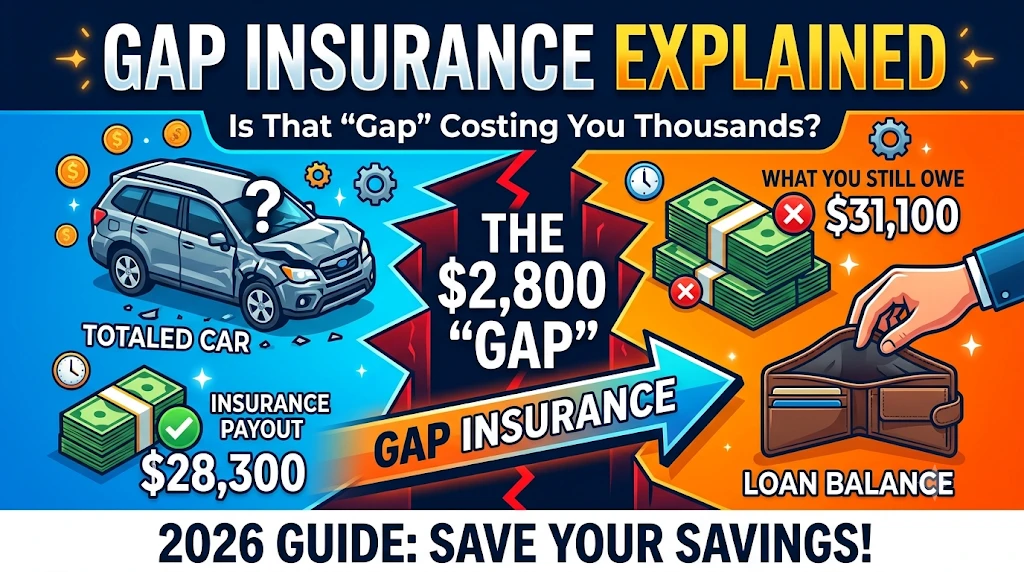
A friend of mine put $1,800 down on a $34,000 SUV last spring, financed the rest over 72 months, and drove off the lot feeling pretty good about the deal. Eight months later, someone ran a red light and totaled it. Her insurer cut a check for $28,300 — what the SUV was worth on the day of the crash. Problem was, she still owed $31,100 on the loan. That $2,800 difference came straight out of her savings account, for a car she no longer had.
That gap, between what a car is actually worth and what you still owe on it, is exactly what gap insurance is built to close. Almost nobody thinks about it until they’re standing exactly where she was, holding a settlement check that doesn’t cover the loan.
This guide breaks down what gap insurance really does, what it costs in 2026, when it saves you real money, and when it’s just $50 a year you’ll never touch. I’ll also get into the exclusions that dealership finance offices tend to gloss over, because that’s usually where people get caught off guard a second time.
What Gap Insurance Actually Covers
Strip away the sales pitch and gap insurance does one job: it pays the difference between your car’s actual cash value (ACV) and what you still owe your lender, if the car is totaled or stolen and never recovered.
That’s the whole function. It isn’t a discount, it doesn’t touch your deductible, and it has nothing to do with repairing fender-benders. It only kicks in once your regular insurer has already declared the car a total loss and paid out its current market value under your comprehensive and collision coverage — gap insurance rides on top of that, it doesn’t replace it.
Here’s where most people get tripped up: they assume their loan balance and their car’s value are roughly the same number. They aren’t, and the gap between them can open fast. Say you finance a $30,000 car with $1,000 down. A year later it’s totaled. Your insurer values it at $24,500 based on depreciation and comparable sales. Your loan balance, after 12 months of payments that went mostly toward interest, is still $27,200. Without gap coverage, you owe $2,700 out of pocket for a car sitting in a salvage yard. With it, that $2,700 gets paid and you walk away clean.
It’s usually sold alongside a handful of other optional coverage add-ons, but unlike roadside assistance or rental reimbursement, this one isn’t about convenience — it’s about not being stuck making payments on a car you can’t drive.
Why the Gap Exists in the First Place
This comes down to two curves moving in opposite directions at different speeds, and insurers understand that math better than most people financing a car do.
A new vehicle typically loses around 20% of its value in the first year alone, then roughly another 15% a year for the next several years — so a car can be worth close to 40% less than its sticker price by year four or five. That drop is steepest right at the start, largely because “new” itself carries a premium that evaporates the moment you drive off the lot.
Your loan doesn’t fall anywhere near that fast. Early payments on a car loan are weighted heavily toward interest rather than principal, especially on longer terms. A 72 or 84-month loan, which has become closer to the norm than the exception, stretches that slow-principal-reduction period out even further. Add a small or zero down payment, and your starting loan balance is already close to — or above — the car’s real value on day one.
Those two lines, fast-falling value and slow-falling debt, cross paths and create a window, usually the first two to three years, where you owe more than the car is worth. Insurers know that window is short, predictable, and statistically manageable, which is exactly why they can afford to sell gap coverage cheaply as a policy add-on. Dealerships, on the other hand, sell it once, in a high-pressure moment when you’re already signing a stack of financing paperwork and not exactly in comparison-shopping mode. That difference in selling environment is basically the entire reason the same coverage costs 5 to 10 times more at the dealer than through your insurer.
Real Numbers: What Gap Insurance Actually Costs
Pricing splits into three fairly distinct tiers depending on where you buy it.
Through your auto insurer: Most major carriers price gap coverage somewhere between $20 and $100 a year, with the national average landing around $85 to $90 annually — roughly $7 a month. It’s typically calculated as a small percentage of your comprehensive and collision premium, which is part of why how your premium gets calculated in the first place matters even for an add-on this small. A cheap-to-insure sedan might add $30 a year to your policy; a fast-depreciating luxury SUV might add closer to $100.
Through the dealership or lender: Expect a flat fee of $400 to $1,000, usually landing between $500 and $700. This isn’t charged separately — it gets rolled directly into your loan amount, meaning you finance it and pay interest on it for the life of the loan. A $700 dealer gap fee financed over 60 months at 7% APR can effectively cost closer to $800 by the time it’s paid off. That’s real money in pure interest, for coverage you could buy elsewhere for a third of the price.
Standalone or credit union policies: Some credit unions and specialty providers sell gap coverage directly for $150 to $400 as a one-time payment, with no interest attached since it isn’t bundled into financing.
Run the math and the pattern is obvious: the exact same protection can cost $90 a year through your insurer or $700+ through the dealer. Insurers aren’t being generous here — they’re pricing a short, low-risk window competitively because they want your entire policy, not just this one line item.
Smart Strategies That Actually Save Money
Buy it from your insurer, not the F&I office. This is the single biggest lever available. Calling your current carrier and adding gap as a rider typically costs 50 to 70% less than the dealer’s flat fee, and you can usually add it within days of financing rather than being pressured into it at signing.
Get quotes from more than one insurer before you finance. Gap pricing isn’t standardized, and comparing quotes properly instead of just accepting whatever your current insurer quotes regularly turns up a $20 to $40 difference on this add-on alone. Small number, but across a 3-year loan that’s real money for five minutes of comparison shopping.
Cancel it the moment you hit positive equity. Gap insurance is only useful during the window where you owe more than the car’s worth — usually the first two to three years. Once your loan balance drops below the car’s value, you’re paying for protection you can’t use. Most insurers will prorate a refund if you cancel early, so check your loan balance against the car’s private-party value once a year and drop the coverage the moment it stops doing anything.
3 More Smart Strategies
Avoid rolling old negative equity into a new loan. This is the one nobody explains at the dealership: if you trade in a car you still owe money on and roll that leftover balance into your new loan, gap insurance on the new car typically won’t cover that rolled-over portion — only the negative equity created by the new vehicle’s own depreciation. Carrying debt forward like this quietly increases your risk while gap coverage quietly excludes the exact part causing it.
Increase your down payment if you can. Putting down 20% or more often shrinks, or entirely eliminates, the gap from day one, since your loan balance starts below the car’s depreciated value instead of above it. It’s a move that pays off in more places than just gap coverage, too — a bigger down payment shows up repeatedly on any list of common mistakes that quietly drive up your total insurance costs.
Check if it’s already bundled in. Some leases include gap protection by default, and a few manufacturer finance programs build it into promotional rates. Read your paperwork before paying for something you may already have.
Pros and Cons
Pros:
- Closes a genuine financial exposure that standard auto insurance doesn’t address — the payout gap is real and can run into thousands of dollars
- Cheap when bought correctly — often under $100 a year through an insurer
- Removes one specific, well-defined source of financial risk during the exact years you’re most exposed to it
- Cancelable once you no longer need it, with prorated refunds available through most insurers
Cons:
- Wildly overpriced when bought at the dealership, often 5 to 10 times the fair cost
- Only useful for a limited window, usually 2 to 3 years, after which it’s dead weight on your policy
- Doesn’t cover negative equity rolled over from a previous loan, missed payments, your deductible, or partial damage
- Easy to forget about and keep paying for years after you actually needed it
Real-Life Scenario: Before and After
Let’s run the numbers on a fairly typical case. A driver finances a $28,000 crossover with $1,200 down (about 4%) on a 72-month loan at 6.5% APR. Sixteen months in, the car is stolen and never recovered.
Without gap insurance: The insurer’s ACV assessment comes back at $22,100, accounting for first-year depreciation plus a few more months of decline. After the $500 deductible, the payout to the lender is $21,600. The remaining loan balance at month 16, given how little principal gets paid down early on a 72-month term, is $24,850. The driver owes $3,250 out of pocket, in cash, for a car that’s gone.
With gap insurance, purchased through the insurer for $65 a year (roughly $87 total across those 16 months): that same $3,250 shortfall gets paid by the gap policy instead. Total cost of the coverage up to that point: under $90. Total amount it saved in this one incident: $3,250. That’s a return that’s hard to argue with, and it’s exactly the scenario gap insurance was designed for — small down payment, long loan term, early total loss.
Flip the down payment to 25% instead of 4% on the same car, and the loan balance at month 16 would likely already sit below the ACV. In that version, gap insurance would have been $65 a year spent on a problem that never existed.
Comparison Table
| Option | Average Cost Impact | Benefit | Risk Level |
|---|---|---|---|
| Add-on through your insurer | $20–$100/year | Full gap coverage, cancel anytime, prorated refunds | Low |
| Dealer or lender flat fee | $400–$1,000 (plus loan interest) | Convenient, bundled into financing | Medium — high overpay risk |
| Standalone/credit union policy | $150–$400 one-time | No markup, no financing interest | Low |
| Skipping coverage (small down payment, 60mo+ loan) | $0 upfront | Saves the premium | High — real exposure to owing thousands |
| Skipping coverage (20%+ down, short loan) | $0 | Saves the premium, minimal exposure | Low |
Expert Insights: What the Fine Print Doesn’t Advertise
A few things worth knowing that rarely come up until you’re actually filing a claim.
The real fight is usually over the ACV, not the gap payout. Gap insurance simply pays whatever amount is left after your primary insurer determines the car’s actual cash value, and insurers calculate that number using their own comparable-sales data, which can come in lower than what you’d get selling the car privately. If you disagree with the ACV, that’s a dispute with your primary insurer, and understanding how claims actually get processed before you’re in that position puts you in a much stronger spot than learning it in the moment.
Rolled-over negative equity is the exclusion that catches people hardest. If you traded in a car you were underwater on and folded that old balance into your new loan, gap insurance on the new vehicle typically won’t touch that portion — it only covers the gap created by the current car’s own depreciation. This single exclusion is one of the most common reasons a gap claim pays out for less than a driver expects, and it’s worth understanding why claims get rejected in general before assuming any add-on covers everything.
Most Important Three
Some policies cap the payout as a percentage of ACV, commonly around 25%, rather than paying the full difference regardless of size. If you’re deep underwater, say from a rollover situation, read your policy’s payout cap before assuming you’re fully protected.
It doesn’t transfer between vehicles. Trade in your car and gap insurance on the old loan disappears with it. You’ll need a new policy for the new vehicle, and it starts the clock over from zero.
Missed payments reduce your payout dollar for dollar, and a lapsed policy at the time of loss pays nothing at all, even if you’d been covered for years beforehand.
Who Should Actually Consider This
It’s genuinely worth it if you:
- Put down less than 20% on a new or lightly-used vehicle
- Financed for 60 months or longer (increasingly the default rather than the exception)
- Are leasing, especially if your lease agreement doesn’t already include it
- Rolled negative equity from a trade-in into your current loan
- Bought a model known for fast depreciation — certain EVs, luxury trims, and larger SUVs lose value quicker than the average sedan
- Are a younger driver financing your first car with limited savings to absorb a surprise shortfall
- Bought a used vehicle on a longer loan term, where the value-to-loan math is often tighter than buyers expect
You can probably skip it if you:
- Put down 20% or more
- Financed for 36–48 months or less
- Paid cash
- Drive something with a strong resale reputation and already have equity in the loan
- Are more than 2–3 years into a standard loan term, where the value-versus-balance math has likely already flipped in your favor
Frequently Asked Questions
Is gap insurance legally required? No state requires it, but some lenders and leasing companies make it a condition of financing, particularly for buyers with low down payments or long terms. Check your loan or lease agreement before assuming it’s optional.
Can I buy gap insurance any time, or only when I finance the car? Most insurers let you add it within the first few years of ownership, not just at the point of purchase, though some cap eligibility by vehicle age or mileage. It’s never retroactive, though — you can’t buy it after a loss and file a claim for that same incident.
Does gap insurance cover my deductible? Usually not, unless your specific policy explicitly says so. This varies more between providers than most people expect, so it’s worth confirming in writing.
What happens to my gap policy if I pay off the loan early or trade in the car? It becomes unnecessary once your loan is paid off, and most insurers will refund the unused, prorated portion if you cancel. It also doesn’t transfer to a new vehicle — you’d need a fresh policy if you finance another car.
3 Most Frequently Asked Questions
Is gap insurance worth it on a used car? Often yes, if you’re financing with a small down payment or a long term, since used cars can still carry meaningful loan balances relative to their value. Many insurers restrict gap eligibility to vehicles under a certain age, so check before assuming it’s available.
Does leasing automatically include gap insurance? Sometimes, but not always — it depends entirely on the leasing company and the specific agreement. Confirm in writing rather than assuming, since the gap on a leased vehicle can be just as real as on a financed one.
How is gap insurance different from “loan/lease payoff coverage”? They’re close cousins. Loan/lease payoff coverage, sold by some insurers as an alternative name for the same concept, sometimes caps the payout at a percentage of the vehicle’s value rather than covering the full difference. Ask specifically which version you’re being offered.
The Bottom Line
Gap insurance solves one narrow, specific problem: the possibility that your car gets totaled during the exact window where you owe more than it’s worth. For some drivers — small down payment, long loan term, fast-depreciating vehicle — that window is real, and the coverage is genuinely cheap insurance against a four-figure surprise.
For others, particularly anyone with 20%+ equity or a short loan term, it’s a premium being paid against a risk that barely exists.
The actual decision isn’t complicated once you strip away the dealership sales pitch: check your down payment percentage, check your loan term. And check whether your current loan balance is above or below the car’s real market value. If you land on the wrong side of that math, add gap coverage through your insurer for a fraction of what the dealer will charge, then set a reminder to cancel it once the numbers flip back in your favor. Pair that with a broader look at where else you might be overpaying on your policy, and gap insurance stops being a mystery line item on your bill and starts being exactly what it should be: cheap, temporary protection for a real but narrow risk.

**Moon Awan** is the founder of MotoPolicy and a research-driven content creator focused on insurance and financial protection topics. With a strong background in building structured digital platforms, he specializes in analyzing and presenting complex insurance information in a clear and practical way.
At MotoPolicy, his work focuses on areas such as car insurance, health insurance, and policy comparison strategies. He continuously studies insurance trends, coverage structures, and pricing models to provide accurate and up-to-date insights that help readers make informed decisions.
His approach combines technical precision with in-depth research, ensuring that every article is well-organized, easy to understand, and useful for real-world applications.
Through MotoPolicy, his goal is to build a trusted resource where users can confidently learn about insurance, compare options, and improve their financial awareness.
While all content is carefully researched, readers are encouraged to consult licensed professionals for personalized insurance advice.




Pingback: Insurance Terminology Explained: A Beginner's Guide to the Words That Actually Cost (or Save) You Money - MotoPolicyHub