
I still remember the exact moment my stomach dropped. I was standing in line at a coffee shop, scrolling through my emails, when I saw it: a completely unceremonious, automated message from my auto insurer stating, “Notice of Policy Cancellation.”
My crime? I had switched banks two weeks prior, updated my debit card for my gym, my streaming services, and my phone bill, but completely forgot to update the auto-pay on my car insurance.
I missed my payment by exactly 14 days.
As a finance writer who literally spends my days dissecting how risk algorithms work, making one of the top mistakes that increase your car insurance cost felt humiliating. But it also gave me a firsthand look at the brutal efficiency of the insurance industry.
If you just realized you missed a payment, take a deep breath. You are likely in a grace period, or if you aren’t, there are specific, logical steps you need to take right now to avoid a financial disaster. Let’s break down exactly what happens, how much it’s going to cost you, and the smartest ways to fix it before things spiral.
Section 1: What This Really Means
When you miss a premium payment, your insurance company doesn’t immediately send the police to your house to strip the plates off your car. Instead, a very specific legal and financial countdown begins.
Insurance is fundamentally a contract. You promise to pay a premium; they promise to transfer your financial risk onto their balance sheet. The moment your payment fails, you enter a grace period.
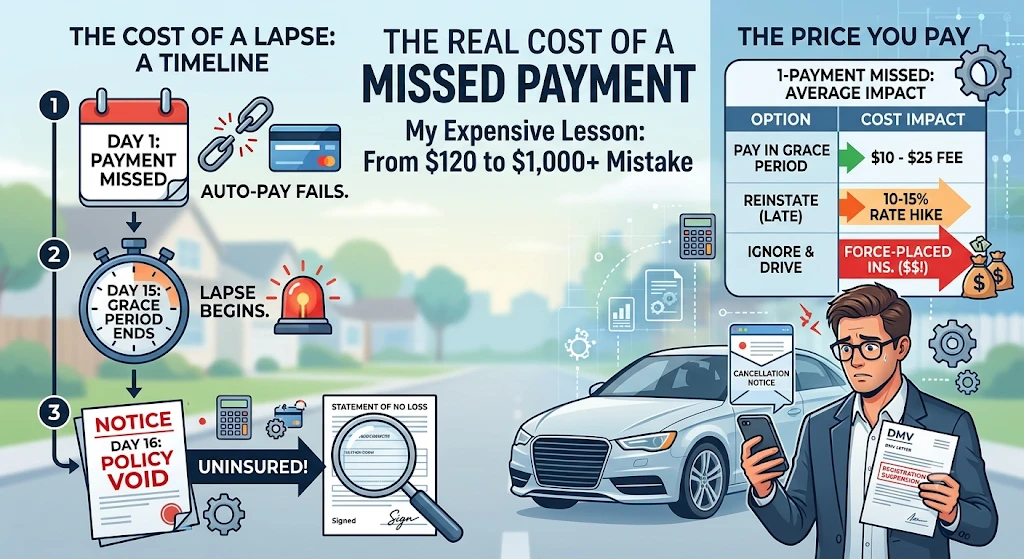
Depending on your state laws and your specific provider, this grace period usually lasts anywhere from 3 to 15 days. If you pay within this window, your coverage continues uninterrupted. You might get slapped with a minor $10 to $25 late fee, but legally, you never lost coverage.
However, if you miss the grace period by even one minute, your policy officially lapses.
A lapse means the contract is void. If you crash your car on day 16, you are driving uninsured. It doesn’t matter if you have a basic state-minimum policy or you spent hours researching what full coverage car insurance really means to protect a brand-new SUV. During a lapse, the insurer owes you absolutely zero financial protection.
Section 2: Why This Happens (The Industry Side)
To fix the problem, you need to understand how the person on the other end of the phone (the underwriter) views you.
Why do insurance companies react so aggressively to a missed payment? Because to an actuary, a missed payment isn’t just an innocent mistake. It is a massive, flashing red indicator of financial instability.
Insurance pricing is entirely based on statistical correlations. Industry data proves, time and time again, that drivers who experience financial stress are significantly more likely to file claims. Why?
- They might delay routine vehicle maintenance (driving on bald tires or worn brakes).
- They might take on extra shifts, leading to drowsy driving.
- They might be distracted by financial worries behind the wheel.
Understanding how insurance companies make money requires understanding that they despise unpredictable risk. When you break your continuous coverage, the algorithm instantly moves you from the “reliable, low-risk” bucket into a higher-risk category. They cancel the policy quickly to cap their exposure.
Section 3: Real Data & Cost Breakdown
Let’s get into the hard numbers, because this is where the real pain happens. A lapse is going to cost you, but the exact amount depends on how you handle it.
Here is a realistic breakdown of what a 30-day lapse does to an average policy costing $1,500 a year:
- Loss of Continuous Coverage Discount: Most insurers give you a hidden 10% to 15% discount just for keeping active insurance for over a year without a gap. Lose this, and your base rate immediately jumps. (Cost: +$225/year)
- The Lapse Penalty Surcharge: The algorithm now views you as a slightly higher risk. You will likely see an 8% to 12% rate hike purely as a penalty for the gap in coverage. (Cost: +$150/year)
- Late/Reinstatement Fees: Administrative fees just to get your paperwork sorted again. (Cost: $25 to $50 one-time)
Total immediate impact: You were paying $1,500. Now, you will likely be quoted around $1,875 for the exact same coverage.
Worse, this penalty doesn’t just disappear next month. Insurance companies look at your past 3 to 5 years of history. That single mistake can easily cost you over $1,100 across three years. This is why younger drivers, who already face brutal premiums, are hit the hardest. If you are in this demographic, looking into car insurance for young drivers reveals that a single lapse can price you out of driving entirely.
Section 4: Smart Strategies That Work
If you missed a payment, do not panic, but do not ignore it. Here is the exact playbook to minimize the financial damage.
Strategy 1: Call and Ask for a “Goodwill Reinstatement”
- Why it works: If you are within 30 days of the cancellation, many carriers will reinstate your original policy with a “Statement of No Loss.” This is a legal document where you swear you haven’t had an accident during the lapse.
- Estimated Impact: Saves you from losing your continuous coverage discount (roughly 15% savings). You keep your old rate, minus a small late fee.
2: Leverage the “New Customer” Market Immediately
- Why it works: If your current insurer refuses to reinstate you without a massive rate hike, fire them. Immediately compare car insurance quotes online from at least three different carriers. Different companies weigh a minor lapse differently. Some will penalize you heavily; others are aggressively trying to acquire new customers and might overlook a 5-day gap.
- Estimated Impact: Drivers who actively shop around after a lapse often reduce their new penalty premium by 15–25%.
3: Re-evaluate Your Payment Structure
- Why it works: Missing payments is often a symptom of cash flow issues or bad automation. If monthly payments are slipping through the cracks, look into the math behind monthly vs annual car insurance payments. Paying in full usually nets you an 8-10% discount and physically removes the possibility of a missed payment lapse.
4: Reassess Your Coverage Needs
- Why it works: If the rate hike is unavoidable, you need to offset it. Evaluate if you actually need every bell and whistle. Knowing exactly which car insurance add-ons you should consider and which to skip can trim $100 to $200 off your premium to offset the lapse penalty.
Section 5: Pros and Cons of Your Next Moves
When faced with a canceled policy due to non-payment, you generally have two choices. Here is the reality of both.
Trying to Reinstate Your Old Policy
- Pro: You preserve your continuous insurance history, which keeps long-term costs down.
- Pro: It is usually the fastest way to get legal to drive again (often takes a 15-minute phone call).
- Con: You must sign a Statement of No Loss. If you scratched a bumper during the lapse, you have to pay out of pocket.
- Con: The insurer might demand the full six-month premium upfront to reinstate you, eliminating your monthly payment option.
Buying a Completely New Policy Elsewhere
- Pro: You get a fresh start and can utilize new-customer sign-up discounts.
- Pro: You can restructure your coverage entirely—maybe finally figuring out if third-party vs comprehensive makes more sense for your current car.
- Con: The new insurer will pull your CLUE report, see the lapse, and price it into your new quote.
- Con: Takes more time and mental energy to research and set up.
Section 6: Real-Life Scenario (The Force-Placed Nightmare)
Let’s look at a scenario that happens every day. My friend Mark drives a financed 2023 Honda Civic. He missed a payment because his debit card was compromised, and his bank issued him a new one. He forgot to tell his auto insurer.
His policy lapsed after a 10-day grace period. Mark ignored the mail, thinking he’d just double up the payment next month.
Here is what nobody warned him about: The DMV and his auto lender found out immediately.
Insurance companies report lapses to the state electronically. His registration was suspended. Worse, his auto lender got notified. Because the lender technically owns the car, they require continuous comprehensive coverage to protect their asset.
When they saw Mark was uninsured, they bought a policy for him. This is called force-placed insurance.
Force-placed insurance only protects the lender, not the driver, and it is outrageously expensive. Mark’s normal premium was $120 a month. The force-placed insurance his lender added to his car loan was $380 a month. By the time Mark realized what happened and bought a new policy from one of the best car insurance companies in 2026, he had spent $760 on useless, forced coverage and had to pay $150 to the DMV to reinstate his registration.
A simple $120 missed payment snowballed into a $1,000+ mistake.
Section 7: Comparison Table
To make this brutally clear, here is what your options look like side-by-side if you just missed a payment today.
| Action Taken | Average Cost Impact | Primary Benefit | Risk Level |
| Pay within Grace Period | $10 – $25 late fee | Policy remains active; no long-term rate hikes. | Very Low |
| Reinstate after Lapse (under 30 days) | ~10% premium increase + $35 fee | Restores continuous coverage history quickly. | Medium (Must sign No Loss statement) |
| Shop for New Policy | Rates vary (usually 10-15% higher) | Can offset lapse penalties with new carrier discounts. | Low (Once active) |
| Ignore & Drive Uninsured | Devastating (Force-placed insurance, tickets, liability) | None. | Extreme (Financial ruin in an accident) |
Section 8: Expert Insights
Here are a few things the customer service rep is not going to tell you on the phone.
1. The “Alternative Data” Factor
Insurers aren’t just looking at your driving record anymore. When you lapse, their pricing engines pull hundreds of data points. If they see a lapse combined with a recent address change to a higher-crime zip code, or a drop in your credit score, they might drop you entirely. This forces you into the non-standard market, requiring you to learn how to navigate car insurance for high-risk drivers, which is easily double the cost.
2. Telematics and Pay-Per-Mile Nuances
If you use a modern, app-based insurance model, missed payments work differently. For instance, when I looked into switching to pay-per-mile car insurance, I learned these accounts act like prepaid cell phones. You pre-fund a balance. If your balance hits zero and your card on file fails to auto-reload, your coverage can be suspended almost immediately, often with zero grace period. You must read the fine print on tech-based insurers.
3. The Claims Risk
If you have an open claim (say, your car is in the shop from a fender bender a month ago) and you miss a payment now, the insurer still has to pay out the old claim because the policy was active at the time of the accident. However, they will be hyper-aggressive about canceling your future coverage. This is a primary reason why insurance claims get rejected or delayed—administrative confusion over payment dates.
Section 9: Who Should Consider This
The path you take after missing a payment depends entirely on your specific situation.
You should urgently push for Reinstatement if:
- You are past the grace period but under the 30-day mark.
- You have a clean driving record and want to protect your “continuous coverage” status.
- You finance or lease your car (to avoid force-placed insurance).
- You live in a state where auto insurance is highly regulated (check the country-wise guide to mandatory insurance rules if you are international or moving abroad).
You should skip reinstatement and Shop for a New Policy if:
- Your current insurer demands a massive rate hike (e.g., over 20%) just to reinstate you.
- You have been lapsed for more than 30 days (most companies won’t reinstate at this point anyway).
- You were already overpaying and just needed an excuse to find the best car insurance for a used car.
Section 10: FAQs
1. Is there a legally required grace period for car insurance?
It depends on your state. Most state laws require insurers to offer a 10-to-15-day grace period before officially canceling a policy, and they must send a written notice of cancellation.
2. Can I legally drive if I missed my payment yesterday?
If you are within your grace period, yes. Your coverage is fully active. If your policy has officially been canceled, absolutely not.
3. Will the DMV find out if my insurance lapses?
Yes. Insurers use electronic reporting systems to notify state DMVs the moment a policy is canceled. Depending on your state, your registration can be suspended within days, and you may be required to file an SR-22 to get your license back.
4. What happens if I get into an accident during a lapse?
You are entirely financially responsible for all damages and medical bills. The insurer will pay nothing. Navigating how to claim car insurance is impossible if the contract was void at the exact time of the accident.
5. Does a missed car insurance payment hurt my credit score?
Insurance companies generally do not report missed premium payments to credit bureaus (unlike credit cards). However, if they send a severely past-due balance to a third-party collection agency, that agency will report it, which can tank your credit score.
6. I’m thinking about skipping insurance entirely because it’s too expensive. Is there another way?
Never skip it. A lapse ruins your future rates. Instead, learn the mechanics of the industry. Read a basic beginner’s guide to what insurance actually is so you can strip out unnecessary coverages, or look into no deposit car insurance options to get started cheaply.
7. Can a lapse affect my other insurance policies?
Sometimes. Many people bundle auto and home/renters insurance. If your auto policy cancels for non-payment, you lose the bundle discount on your other policies immediately, driving up your overall living costs. (This same logic applies to bundling life or health products—if you are navigating how to choose the right health insurance plan, keep your billing separate to isolate risks).
Conclusion
Missing a car insurance payment is a masterclass in how aggressively the financial system reacts to minor errors. I learned the hard way that an expired debit card can quickly spiral into a canceled policy, lost discounts, and sheer panic.
The biggest takeaway here is speed. Time is literally money when dealing with a lapsed policy. If you catch it within the grace period, pay it immediately and set up calendar reminders so it never happens again. you’ve officially lapsed, swallow your pride, pick up the phone, and try to negotiate a reinstatement with a Statement of No Loss.
If they won’t play ball, don’t stay loyal to a company punishing you. Go online, run new quotes, and protect yourself. Driving uninsured isn’t just illegal; it is a financial gamble that can bankrupt you in a split second. Fix the paperwork today, automate your payments tomorrow, and get back on the road with peace of mind.

**Moon Awan** is the founder of MotoPolicy and a research-driven content creator focused on insurance and financial protection topics. With a strong background in building structured digital platforms, he specializes in analyzing and presenting complex insurance information in a clear and practical way.
At MotoPolicy, his work focuses on areas such as car insurance, health insurance, and policy comparison strategies. He continuously studies insurance trends, coverage structures, and pricing models to provide accurate and up-to-date insights that help readers make informed decisions.
His approach combines technical precision with in-depth research, ensuring that every article is well-organized, easy to understand, and useful for real-world applications.
Through MotoPolicy, his goal is to build a trusted resource where users can confidently learn about insurance, compare options, and improve their financial awareness.
While all content is carefully researched, readers are encouraged to consult licensed professionals for personalized insurance advice.



